
Introduction
Municipal IT departments are caught in a difficult position. Citizen demand for digital services keeps rising—online permit applications, utility payments, court record access, emergency notifications—while the infrastructure supporting those services sits in aging server rooms that were never designed for today's workloads.
According to a 2025 NLC survey of 206 municipalities, 84% cited insufficient capital budgets as an obstacle to infrastructure improvement, with 64% reporting uncertainty about future funding. Compounding this, the 2025 State and Local Government Workforce Survey found 41% of respondents identified IT as hard to fill, with 62% reporting fewer qualified applicants than open positions.
Colocation—moving government-owned servers into a professionally managed, third-party data center—addresses both problems directly. This guide covers what municipal colocation is, why local governments are adopting it, the key compliance requirements, and how to select the right provider.
Key Takeaways
- Municipal colocation lets governments keep hardware ownership while gaining enterprise-grade infrastructure
- Compliance requirements vary: CJIS, NIST SP 800-53 Rev. 5, and SOC 2 Type 2 are the most critical frameworks to evaluate
- Managed colocation suits smaller municipalities with lean IT teams
- Unmanaged colocation works better for well-staffed departments that handle their own systems
- Colocation converts unpredictable capital expenditure into a predictable monthly operating cost
- Provider selection should prioritize compliance documentation, uptime history, and contract flexibility over price alone
What Is Municipal Server Colocation?
Municipal server colocation is a model where a city, county, or local government agency moves its own servers and networking equipment into a third-party data center. The municipality pays for physical space, power, cooling, and connectivity—but retains full ownership and control of its hardware and data. That distinction separates colocation from cloud computing entirely.
Colocation vs. Cloud: A Critical Difference for Government
Cloud platforms like AWS, Azure, and Google Cloud provide virtualized compute resources running on shared, provider-owned infrastructure — the agency owns nothing physical. With colocation, the municipality's servers sit in a dedicated cage or rack, and the agency controls the hardware, the operating system, and every software layer running on top.
For governments with public records obligations, open records laws, and accountability requirements, this control is often non-negotiable. Shared cloud environments can create complications around data access, audit trails, and transparency that colocation avoids by design.
Two Colocation Formats Worth Understanding
| Format | What the Provider Supplies | What the Municipality Manages |
|---|---|---|
| Retail/Unmanaged | Facility space, power, cooling, connectivity | Hardware, software, monitoring, patching, troubleshooting |
| Managed | All of the above plus monitoring, maintenance, remote hands, and support | Strategic IT decisions and application-layer management |
The "managed" label means different things at different providers. Data Center Knowledge notes that providers use this term inconsistently—municipalities should request a written responsibility matrix rather than relying on the label alone.
Why Municipal Governments Are Moving Away from On-Premise Infrastructure
The State of the Typical Municipal Server Room
Most municipal server rooms weren't designed as data centers. They're converted closets or basement rooms housing hardware purchased under capital budgets a decade ago. Redundancy is minimal, and the IT staff responsible for keeping them running are already stretched across too many other priorities.
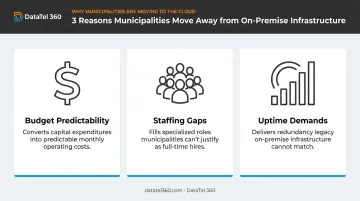
Three compounding problems drive the move away from on-premise:
- Converts unpredictable capital expenditures into predictable monthly operating costs, sidestepping multi-year procurement cycles that make technology refresh nearly impossible
- Fills critical staffing gaps — power engineers, physical security specialists, and network architects — that most municipal IT departments can't justify as full-time hires; colocation providers include these specialists as part of the service
- Delivers the uptime that citizens now expect from online permitting, utility payments, and records access, which legacy on-premise infrastructure with no redundant power or cooling routinely fails to provide
The budget timing problem deserves special attention. When a municipality discovers its server room needs upgraded power distribution or cooling in March, mid-cycle emergency capital requests are difficult to approve — and the infrastructure gap doesn't wait. Shifting facility costs to a predictable monthly operating fee removes that risk from the municipality's plate entirely.
Key Benefits of Colocation for Local Government IT
Reliability and Physical Security
Purpose-built colocation facilities are engineered around redundancy in ways a municipal server room simply cannot match. The Uptime Institute's Tier classification system describes facilities by their topology and maintenance capabilities:
- Tier I/II: Basic redundant components; planned maintenance may require shutdowns
- Tier III: Concurrently maintainable—any single component can be taken offline for maintenance without affecting operations
- Tier IV: Fault tolerant—a single equipment failure or distribution path interruption does not affect operations
For public-facing services like emergency dispatch, tax systems, or permit portals, a Tier III or IV facility provides a structural reliability advantage that no municipal server room renovation can realistically replicate.
Physical security follows the same pattern. Professional colocation facilities layer biometric access controls, 24/7 on-site personnel, CCTV surveillance, mantraps, and locked cages.
CJIS Security Policy v6.1 specifies enforceable controls—including PE-3 credential verification, PE-6 surveillance with quarterly log review, and PE-8 visitor records retained for one year—that a professional colocation facility is designed to satisfy. A municipal server room with badge access at the door typically is not.
Scalability and Disaster Recovery
Scalability and disaster recovery are where on-premise infrastructure consistently falls short—both in capability and in cost to close the gap:
- Scalability without capital requests: Colocation lets a municipality add rack space, power, or bandwidth as needs grow—without a city council capital approval for physical construction. This matters especially for municipalities rolling out smart city technology or expanding citizen-facing applications.
- Disaster recovery by geography: Housing servers in a professionally managed facility outside a municipal building creates natural separation from local events—floods, fires, severe weather—that could take a city hall offline. Many colocation agreements include options for redundant or secondary sites to further reduce single-point exposure.
Cost Visibility
Colocation replaces unpredictable infrastructure costs with a transparent monthly line item. The core cost drivers are straightforward:
- Rack or cage footprint
- Committed power draw
- Bandwidth allocation
- Any managed services included
Hidden expenses—aging facility maintenance, power overruns, staff time, emergency hardware replacement—get replaced by a fixed, auditable charge. For municipalities operating under tight budget scrutiny, that shift makes infrastructure spending far easier to defend in annual budget reviews.
Government-Specific Compliance and Security Requirements
Compliance requirements should drive your vendor shortlist before detailed evaluation begins — providers who can't meet the relevant standards aren't worth evaluating further.
CJIS: The Law Enforcement Standard
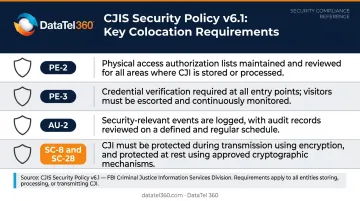
Any municipality housing law enforcement systems—criminal records, dispatch data, investigative files—must work with colocation providers assessed against the CJIS Security Policy v6.1 (June 25, 2026). Key requirements include:
- PE-2: Access authorization lists for anyone with physical access to areas containing Criminal Justice Information (CJI)
- PE-3: Credential verification and escorted visitor protocols
- AU-2: Logging of specified security events with regular review
- SC-8 and SC-28: Protection of CJI in transmission and at rest
If a municipality controls its own encryption keys and provider personnel cannot reach unencrypted CJI, Appendix G of the CJIS policy describes a meaningful screening exception. Municipalities should work through this analysis with legal counsel before assuming full provider vetting is required.
NIST SP 800-53 and SOC 2
NIST SP 800-53 Rev. 5 (Release 5.2.0, August 27, 2025) is available for voluntary use by nonfederal organizations. It doesn't automatically apply to municipalities — applicability typically arises from:
- Specific grant award terms or federal program participation
- Contract language tied to federal funding sources
- Voluntary adoption as a security baseline
Where NIST applicability depends on your funding structure, SOC 2 Type 2 applies universally. These reports provide third-party audit evidence that a provider's controls around security, availability, and confidentiality were operating effectively over a defined period. Requiring a SOC 2 Type 2 report is a reasonable procurement baseline for any municipality evaluating colocation providers.
State-Level Data Governance
Data residency requirements and public records laws vary by state. Florida's Chapter 119, for example, requires custodians to permit inspection and copying of public records and imposes specific duties on contractors handling government data—but does not establish an in-state storage mandate. Municipalities should confirm their own state's specific requirements with legal counsel before executing a colocation contract, and verify the provider's ability to support state-specific data governance needs.
Managed vs. Unmanaged Colocation: What's Right for Your Municipality?
The managed/unmanaged decision comes down to three honest questions:
- What is your IT team's actual capacity? Not headcount—actual bandwidth for ongoing infrastructure management after the migration.
- How critical and complex are the systems being colocated? Emergency dispatch or financial systems demand different oversight than a document storage server.
- What does self-management actually cost? Staff time spent troubleshooting colocation infrastructure isn't free. Calculate the true cost before assuming unmanaged is cheaper.
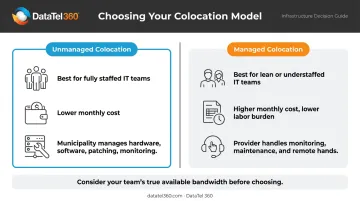
Here's how the two models compare:
| Unmanaged Colocation | Managed Colocation | |
|---|---|---|
| Who it suits | Technically capable, fully staffed IT departments | Smaller municipalities or lean IT teams |
| What's included | Facility, power, cooling, physical security | All of the above + monitoring, maintenance, remote hands, OS-level support |
| Municipality's responsibility | Everything above the physical layer | Primarily hardware ownership and policy decisions |
| Monthly cost | Lower | Higher, but reduces internal labor burden |
Unmanaged works when your team can genuinely absorb hardware installation, patching, monitoring, and troubleshooting on top of existing responsibilities. The facility is yours to use; the management is yours to handle.
Managed colocation costs more per month, but the math often favors it. 62% of state and local government HR respondents reported fewer qualified IT applicants than open positions — a staffing reality that makes outsourced infrastructure oversight worth serious consideration for most mid-sized and smaller municipalities.
How to Select the Right Colocation Provider for Your Municipality
Step 1: Require Compliance Documentation Upfront
Before shortlisting any provider, require:
- SOC 2 Type 2 audit report (not just an attestation letter)
- NIST 800-53 alignment documentation if federal programs are involved
- CJIS Security Addendum if law enforcement systems will be colocated
- HIPAA-compatible controls if health department systems are in scope
Providers who cannot produce third-party audit documentation should be removed from consideration.
Step 2: Evaluate Location, Connectivity, and Redundancy
Key criteria:
- Geographic proximity: IT staff need to reach the facility for physical work — factor in realistic travel time, not just mileage
- Carrier-neutral connectivity: Multiple ISPs in the facility allow redundant connections and provider switching without relocating equipment
- Historical uptime: Request actual uptime records, not just advertised SLAs. Tier certification describes facility topology — it is not a contractual uptime guarantee
Step 3: Verify Contract and Procurement Compatibility
Municipal procurement often requires competitive bidding and RFP processes. Contracts must align with multi-year budget cycles. Municipalities should confirm:
- Contract terms match budget cycle lengths
- Contract allows for early exit or modification if service levels aren't met
- Provider can participate in formal procurement processes
Regional providers bring practical advantages in this process. DataTel 360, based in Atlanta and serving government and enterprise clients across Georgia and the Southeast for more than 25 years, offers 24/7 emergency support with local on-site response — a meaningful difference when procurement timelines and service continuity are both at stake.
Their services cover what municipalities actually need during a colocation transition: smart hands and remote hands support, structured cabling to TIA standards with Fluke-certified testing, fiber optic installation with OTDR-verified documentation, and MDF/IDF buildouts. Every installation includes labeled panels and as-built drawings — documentation that holds up to public-sector audits and procurement accountability reviews.
Frequently Asked Questions
What is a colocation server?
A colocation server is a physical server owned by an organization—such as a municipality—that is housed in a third-party data center rather than on the owner's premises. The data center provides power, cooling, connectivity, and physical security, while the organization retains full ownership and control of the hardware and data.
What are hyperscalers vs. colocation?
Hyperscalers like AWS, Microsoft Azure, and Google Cloud provide virtualized computing resources on shared, provider-owned infrastructure. Colocation means housing your own physical hardware in a third-party facility. Governments often prefer colocation because it preserves hardware ownership and avoids shared-tenant concerns that can complicate public records and data accountability obligations.
What compliance certifications should a colocation provider have for municipal use?
Municipalities should require a SOC 2 Type 2 audit report as a baseline. Beyond that, requirements depend on the data involved:
- Law enforcement data: Assessment against CJIS Security Policy v6.1
- Federal programs: NIST SP 800-53 Rev. 5 alignment may be required
- Health departments: Confirm HIPAA-compatible controls
- Public records: Verify state-specific obligations with legal counsel
How much does municipal server colocation typically cost?
Costs vary based on rack footprint, power draw, bandwidth, connectivity ports, and whether managed services are included. Colocation also eliminates hidden on-premise costs—facility maintenance, hardware refresh, and specialized staffing—that make in-house infrastructure more expensive than it appears on paper.
Can small municipalities or townships benefit from colocation?
Small municipalities often benefit most. They typically lack the budget, staff, and facility infrastructure to maintain enterprise-grade hardware environments in-house. Colocation gives even a small township access to professional-grade redundancy, physical security, and connectivity at a fraction of what a comparable private data center would cost to build and maintain.
What is the difference between managed and unmanaged colocation for government agencies?
Unmanaged colocation provides only the physical facility and connectivity—the agency handles all hardware and software management. Managed colocation adds provider-handled monitoring, maintenance, and support services at a higher monthly cost, which makes it a practical fit for municipalities with limited internal IT capacity.