Introduction
Telecom fraud is a massive and growing problem. According to the Communications Fraud Control Association, global telecom fraud losses reached $38.95 billion in 2023 — roughly 2.5% of total telecom revenue, up 12% from 2021.
Voice communications sit at the center of that target. SIP trunking has replaced traditional copper phone lines for thousands of businesses, cutting costs and adding flexibility. But SIP operates over the open internet, and most SIP connections are not encrypted by default.
That means call metadata, routing details, and the voice audio itself travel across public networks in plain text — readable by anyone positioned to intercept the traffic.
This guide covers:
- What secure SIP trunking actually means
- Why standard configurations leave businesses exposed
- How TLS and SRTP encryption work together to protect calls
- The most common threats your phone system faces today
- What to look for when evaluating a provider
Key Takeaways
- Most SIP trunks transmit signaling data unencrypted by default — securing them requires explicit configuration, not just a provider checkbox
- Full protection requires two protocols working simultaneously: TLS for call setup data and SRTP for voice audio
- Toll fraud, registration hijacking, and MITM attacks target unprotected SIP infrastructure
- Healthcare, legal, and financial services organizations face compliance obligations that effectively require encrypted voice
- Choose a provider that enables encryption by default — opt-in add-ons leave gaps attackers can exploit
What Is SIP Trunking and Why Does Security Matter?
RFC 3261 defines SIP (Session Initiation Protocol) as an application-layer signaling protocol for creating, modifying, and terminating communication sessions. In plain terms: a SIP trunk is a virtual phone line that connects your business phone system (PBX) to the public telephone network over the internet, replacing physical copper lines while supporting voice, video, and messaging.
That internet-based delivery is what makes SIP trunking flexible and cost-effective — and what exposes it to the same attack surface as any other internet traffic.
The Security Gap Traditional Lines Didn't Have
Legacy PSTN phone systems ran over closed, private circuits. Intercepting them required physical access to the line. SIP trunks, by contrast, use the same public internet pathways as email and web traffic — which means they face the same class of threats.
An attacker doesn't need to be in your building. They need network access to traffic between your PBX and your SIP provider, which is far easier to obtain than most businesses realize.
Who Faces the Highest Risk
That exposure isn't equal across industries. Organizations that transmit regulated or privileged information over voice channels carry significantly higher risk:
- Healthcare organizations — patient conversations and appointment details fall under HIPAA's electronic PHI protections
- Legal firms — attorney-client privileged communications conducted over VoIP
- Financial services — calls involving account data, payment processing, or card details enter PCI DSS scope
- Government contractors — sensitive program discussions subject to federal security requirements
For these organizations, secure SIP trunking is a compliance requirement, not just a best practice. Unencrypted voice traffic can trigger HIPAA, PCI DSS, or federal security violations with real financial and legal consequences.
Why Standard SIP Trunks Are Not Secure by Default
Standard SIP configurations transmit signaling data over unencrypted connections — typically UDP on port 5060 — and most businesses don't realize this until after a problem surfaces. That means call metadata — including caller ID, device IP addresses, routing instructions, and session parameters — travels across the internet in plain text.
What Plain-Text Signaling Exposes
An attacker positioned between your phone system and your SIP provider has full visibility into every unencrypted SIP message in transit. That access enables:
- Read SIP messages as they pass through
- Harvest caller IDs, device information, and internal network details
- Manipulate routing instructions without either party knowing
- Use collected data for fraud, social engineering, or targeted follow-on attacks
NIST addresses this directly in its Security Considerations for Voice Over IP Systems — it's not a theoretical edge case, but a documented attack class with real-world consequences.
The "My Provider Handles It" Assumption
Many businesses assume their SIP provider's security covers them. It doesn't — at least not completely.
Even when a provider encrypts their side of the connection, an unprotected PBX or on-premise phone system leaves a gap. Both endpoints must be configured for encrypted signaling and media — and the business is responsible for their end of that equation.
How Secure SIP Trunking Works: TLS and SRTP Explained
Securing a SIP trunk requires protection at two distinct layers. Each handles a different part of the communication, and both must be active simultaneously.
Signaling Encryption with TLS
Transport Layer Security (TLS) encrypts the SIP signaling messages — the packets that carry call setup data like phone numbers, caller identity, routing instructions, and session parameters.
The HTTPS analogy fits well: just as TLS seals web traffic against interception, it creates a tamper-proof channel for SIP signaling. Without TLS, signaling data is readable in plain text, giving attackers a detailed map of your phone system's structure and activity.
What to require:
- TLS 1.3 capability, with TLS 1.2 as the minimum acceptable fallback
- Port 5061 (the IANA-registered SIP-TLS port) rather than the unencrypted default on port 5060
Media Encryption with SRTP
Secure Real-Time Transport Protocol (SRTP) handles the actual voice audio once a call is in progress. Without it, voice travels as raw RTP packets — and anyone with basic network tools can capture those packets and reconstruct them into audible conversations.
RFC 3711 defines SRTP as providing confidentiality, message authentication, and replay protection for media streams. It closes the gap that TLS alone leaves open.
Why Both Protocols Must Work Together
Neither protocol is sufficient on its own:
| Protocol | What It Protects | What It Leaves Exposed |
|---|---|---|
| TLS only | Call setup, routing, metadata | Voice audio (RTP packets) |
| SRTP only | Voice audio content | Call metadata, signaling |
| TLS + SRTP | Full protection | Nothing — both layers covered |
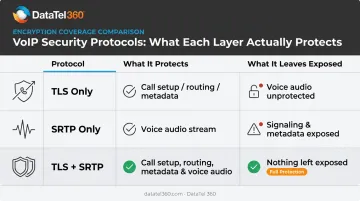
That gap matters in practice: an attacker blocked from your audio can still mine exposed signaling data for call patterns, internal extensions, and routing topology. Closing both layers is what makes a SIP trunk genuinely secure — which is exactly where Session Border Controllers come in.
The Role of Session Border Controllers
Session Border Controllers (SBCs) function as specialized firewalls for SIP traffic. They manage encryption handshakes, enforce access policies, rate-limit suspicious traffic, and hide your internal network topology from outside parties.
SBCs enforce capabilities including TLS/SRTP negotiation, SIP authentication, topology hiding, and rate-based DoS defenses. Businesses without an SBC at their network edge are missing a layer of protection that encrypting signaling and media alone cannot fully replace.
Common SIP Security Threats Businesses Face Today
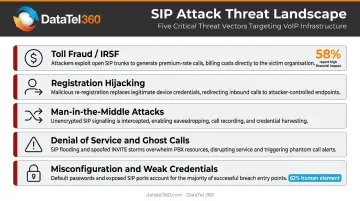
Toll Fraud and IRSF
International Revenue Share Fraud (IRSF) involves attackers exploiting unsecured SIP accounts to place unauthorized calls to premium-rate international numbers. Automated attack tools run around the clock — businesses can accumulate tens of thousands of dollars in fraudulent charges over a single weekend before detecting the problem.
According to the i3Forum's 2023 fraud study, 58% of respondents rated IRSF as a high challenge — making it one of the most widespread and financially damaging threats in the voice fraud landscape.
Registration Hijacking
An attacker impersonates a legitimate SIP user agent at the registrar, replacing the real device's contact binding with their own. Once they control the registration, they can intercept incoming calls, place unauthorized outbound calls, or eavesdrop — often without triggering standard security alerts.
Man-in-the-Middle Attacks
On unencrypted SIP connections, an attacker who gains access to network traffic between a business and its SIP provider can intercept call content, harvest credentials, and inject fraudulent SIP messages. Research has demonstrated that remote attackers (not just those with local network access) can execute VoIP MITM attacks by exploiting DNS and SIP weaknesses in combination.
Denial of Service and Ghost Calls
SIP infrastructure can be targeted with floods of malformed packets designed to overwhelm phone systems and knock communications offline. Ghost calls, phantom inbound connection attempts from automated scanners, are often the precursor. They probe SIP systems for weaknesses before a more targeted attack follows.
Misconfiguration and Weak Credentials
Not every SIP breach involves sophisticated hacking. Many exploit entirely preventable errors:
- Default passwords left unchanged
- Administrative ports left open to the internet
- Security features disabled during installation and never re-enabled
- Expired TLS certificates causing silent fallback to unencrypted connections
The 2025 Verizon Data Breach Investigations Report found a human element in 62% of breaches — misconfiguration and credential misuse consistently rank among the leading causes across industries.
Best Practices for Securing Your SIP Trunks
Enforce TLS and SRTP at Both Ends
Encryption must be active at the provider level and at your PBX — not left as optional. Verify your current configuration:
- Signaling uses port 5061 (not UDP port 5060)
- SRTP is active on all media streams
- TLS certificates are valid and not expired (expired certificates often trigger silent fallback to unencrypted connections)
Deploy a Session Border Controller
An SBC at your network edge is a core security control for any business with real call volume or compliance requirements. A properly configured SBC will:
An SBC at your network edge is a core security control for any business with real call volume or compliance requirements. A properly configured SBC will:
- Manage encryption sessions end-to-end
- Enforce access policies at the network perimeter
- Hide internal network topology from outside visibility
- Rate-limit suspicious or anomalous traffic
- Block unencrypted fallback connections
Implement IP Whitelisting and Strong Access Controls
- Restrict SIP trunk connections to approved IP addresses only
- Use strong, unique passwords for all SIP accounts
- Apply role-based access controls limiting administrative privileges to authorized personnel
- Never leave default credentials in place
Set Up Real-Time Monitoring and Anomaly Detection
Passive security measures aren't enough. Active monitoring should establish normal call traffic baselines and alert administrators to:
- Sudden spikes in international call volume
- Off-hours call activity
- Calls to high-risk geographic destinations
- Unusual spending patterns
Automated spending thresholds and geographic call restrictions add an additional enforcement layer.
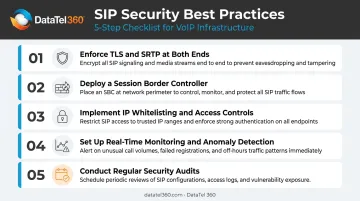
Conduct Regular Security Audits
SIP security is ongoing, not a one-time setup. Schedule periodic reviews of PBX configurations, validate TLS certificates before they expire, and keep phone system firmware current to support modern TLS standards.. If you're unsure where your current configuration stands, a qualified telecom contractor can audit your SIP environment and identify gaps before they become incidents.
What to Look for in a Secure SIP Trunk Provider
Encryption Enabled by Default
Encryption should be included in the standard configuration — not an optional add-on requiring extra cost or manual activation. Ask directly: is TLS enabled by default, or does it require additional steps? Is SRTP active on all media streams out of the box?
STIR/SHAKEN Compliance and Fraud Prevention
STIR/SHAKEN is the FCC-mandated framework for caller ID authentication. By mid-2025, approximately 84% of traffic between major US providers was signed and verified under this framework. While STIR/SHAKEN does not encrypt calls — it authenticates the originating caller ID — it's a meaningful fraud prevention layer.
Look for a provider that can demonstrate:
- Their STIR/SHAKEN compliance level (A-level attestation is the strongest)
- Real-time fraud monitoring and call spending alerts
- Automatic blocking of suspicious traffic patterns
Verified Expertise and Industry Familiarity
For businesses in regulated industries, the provider's familiarity with compliance requirements matters. A provider that has helped healthcare organizations navigate HIPAA considerations or financial services firms address PCI DSS voice channel scope is better positioned than one offering a one-size-fits-all solution.
DataTel 360, for example, takes a carrier-neutral approach to SIP trunking — meaning recommendations are based on your organization's actual requirements rather than a preferred vendor relationship. For Atlanta and Southeast US businesses, that kind of independent guidance can make a real difference when evaluating providers across healthcare, financial services, and multi-location environments.
Frequently Asked Questions
What is a SIP trunk?
A SIP trunk is a virtual phone line that connects your business's internal phone system (PBX) to the public telephone network over the internet using the Session Initiation Protocol. It replaces traditional copper phone lines and supports voice, video, and messaging.
What is the difference between TLS and SRTP in SIP trunking?
TLS encrypts the SIP signaling layer — the call setup and routing data, including phone numbers and device information. SRTP encrypts the actual voice audio stream. Both must be active simultaneously; each covers a different layer, and neither substitutes for the other.
Is SIP trunking secure by default?
No. Most SIP trunks transmit signaling over unencrypted connections on port 5060 by default. Both your SIP provider and your own phone system must be explicitly configured to use TLS for signaling and SRTP for media to achieve full protection.
Does SIP trunk encryption affect call quality?
Properly implemented TLS and SRTP add negligible overhead. The primary factors affecting call quality are internet bandwidth, network congestion, and codec selection — not the encryption layer itself.
What compliance regulations require secure SIP trunking?
HIPAA requires appropriate safeguards for electronic PHI, including VoIP communications that involve patient data. PCI DSS applies to any VoIP component through which cardholder data flows. Both regulations treat unencrypted voice traffic as a compliance gap.
How can I tell if my current SIP trunk is encrypted?
Check your PBX configuration for TLS on port 5061 (not UDP/TCP on port 5060) and confirm SRTP is enabled for media. Then ask your provider whether encryption is active by default or requires manual setup.