For IT managers, facilities directors, and operations leaders, the stakes are straightforward: fiber optic infrastructure is not self-maintaining, and waiting for failures is an expensive strategy.
This guide covers what fiber optic MRO actually includes, how to spot early warning signs before outages occur, the business case for proactive maintenance, and what separates a capable MRO partner from a generic repair vendor.
Key Takeaways
- Dirty connectors cause 80% of field-test failures — inspection and cleaning should happen at every connection event
- Fiber faults often appear as intermittent slowdowns first, making them easy to misdiagnose as software issues
- OTDR testing maps the entire fiber run and pinpoints exact fault locations before any repair work begins
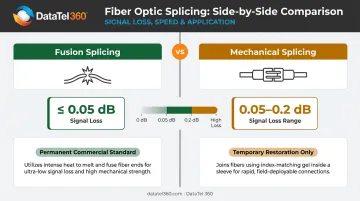
- Fusion splicing introduces 0.05 dB or less signal loss and is the standard for permanent commercial repairs
- Proactive maintenance stops compounding signal loss before marginal links fail during upgrades
What Is Fiber Optic System MRO?
MRO stands for Maintenance, Repair, and Operations — and in the context of fiber optic infrastructure, it covers three distinct functions:
- Maintenance: Scheduled inspections, connector cleaning, performance testing, and documentation updates
- Repair: Fusion splice restoration, connector replacement, and fault isolation using OTDR diagnostics
- Operations support: As-built records, fiber maps, monitoring baselines, and change management documentation
The key distinction is that MRO is ongoing infrastructure stewardship, not just emergency response. A break-fix model only activates when something fails. A true MRO program catches degradation before it reaches failure thresholds.
Why Fiber Requires Its Own Discipline
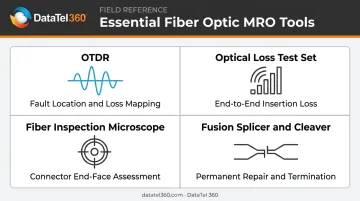
Most internal IT teams are not equipped for fiber plant work. The toolset alone separates it from general helpdesk support:
| Tool | MRO Function |
|---|---|
| OTDR (Optical Time Domain Reflectometer) | Fault location, loss mapping, baseline documentation |
| Optical Loss Test Set (OLTS) | End-to-end insertion loss measurement |
| Fiber inspection microscope | Connector end-face assessment |
| Fusion splicer and precision cleaver | Permanent fiber repair and termination |
Even minor issues — a dirty connector, a stressed bend, a degraded splice — create measurable signal loss. That loss compounds across multiple connection points and can affect every application running on the infrastructure.
Those compounding losses are exactly why industry standards exist. ISO/IEC 14763-3:2024 and ANSI/TIA-568.3-E define the inspection, testing, and performance benchmarks that any qualified MRO provider follows.
Warning Signs Your Fiber Infrastructure Needs Attention
Fiber faults rarely announce themselves with a complete outage. They typically surface as intermittent problems that get misdiagnosed as software bugs or equipment glitches. Recognizing the early warning signs is what prevents a slow-burn fault from becoming a full network failure.
Performance and Monitoring Indicators
- Intermittent slowdowns that correlate to recent physical events — new construction, moved equipment, HVAC work, or heavy foot traffic near cable pathways
- Elevated signal attenuation or high bit error rates showing up in network monitoring that consistently exceed the link's calculated loss budget
- Poor throughput or dropped connections on newly installed or reconnected equipment following moves, adds, or changes (MACs)
When end-to-end loss measurements drift significantly from the installation baseline, a technician should perform OTDR testing to pinpoint the location and cause.
Physical and Operational Indicators
- Kinked or crushed cable jackets near equipment racks or conduit transitions
- Cables that have been disturbed by other trades — construction crews, HVAC contractors, and electricians frequently damage fiber runs without realizing it
- Improper bend radius at patch panels, particularly where cables are dressed too tightly around corners
- Support tickets concentrated in a specific building zone or floor — localized complaints that don't resolve with equipment reboots point strongly to a fiber plant fault in that area
Common Causes of Fiber Optic Failures in Commercial Environments
Three failure categories account for the majority of fiber problems in commercial and industrial facilities.
Connector Contamination
According to VIAVI, dirty connectors cause 80% of field-test failures. Fluke similarly identifies contamination — from dust, fingerprints, and oils — as the leading cause of fiber link failure and excessive loss.
The problem is invisible without a fiber inspection microscope. Debris accumulates on mating surfaces during normal handling and patch cord swaps. When a contaminated end-face mates with a clean one, debris can embed permanently, converting a cleanable problem into a damaged ferrule that requires full replacement.
Physical Stress and Installation Damage
Glass fiber strands are durable when properly routed but have zero tolerance for sustained mechanical stress. Common culprits include:
- Cables bent beyond the manufacturer's minimum bend radius
- Runs pinched in conduit, compressed by ceiling tiles, or pulled across sharp edges
- Post-installation disturbance by other trades working in the same ceiling or wall cavity
The FOA guidance cites general values of 10 times cable diameter for installed radius and 20 times under maximum pulling load — but the installed cable's data sheet governs.
Environmental Factors
Commercial and industrial environments introduce specific risks:
- Moisture infiltration in outdoor or campus runs and in building penetrations
- Temperature cycling in plenum or attic spaces that causes jacket brittleness over time
- Rodent damage in warehouses, manufacturing, and logistics facilities where fiber runs near ground level or in open cable trays
DataTel 360's field teams encounter these conditions regularly across the Southeast, particularly in distribution centers, manufacturing plants, and campus inter-building runs where fiber is exposed to the full range of Georgia's climate.
What Fiber Optic MRO Services Typically Include
A complete MRO engagement covers diagnosis, repair, and documentation — not just the single task that triggered the service call.
OTDR Diagnostic Testing
An OTDR sends light pulses through the fiber and measures backscatter and reflections versus distance. The output maps the entire run, measuring loss at each connector and splice, locating bends and breaks, and characterizing every event by type and severity.
OTDR testing supports both TIA testing tiers, and both matter for complete fiber MRO:
- Tier 1 measures end-to-end loss to confirm whether the link passes
- Tier 2 adds event-level characterization to show where problems are and why
Retaining installation traces as baselines is what makes future troubleshooting fast and accurate.
Fusion Splicing and Splice Repair
Fusion splicing permanently joins two fiber strands using an electric arc, creating a continuous glass path. Corning's application data puts fusion splice loss at 0.05 dB or less, compared to 0.05–0.2 dB for mechanical splices. Fusion is the standard for permanent commercial repairs; mechanical splices are reserved for rapid temporary restoration when fusion equipment isn't available.
DataTel 360 performs fusion splicing in-house on both single-mode and multimode fiber, with OTDR verification following each repair.
Connector Inspection, Cleaning, and Replacement
Using fiber microscopes, technicians inspect end-faces against IEC 61300-3-35 criteria before mating any connector. Clean connectors get cleaned with appropriate tools and solutions. Connectors with physical damage that cleaning cannot correct get replaced. This is a core preventive task that reactive-only programs frequently skip , and it's exactly how facilities accumulate the contamination buildup that eventually leads to failures.
Cable Plant Documentation
Every MRO engagement should produce updated records: fiber maps, labeled runs, OTDR trace files, and test results in a format the client can actually use.
DataTel 360 delivers PDF as-built turnover packages on every project, including OTDR-tested fiber documentation, panel labeling, and port schedules. Future technicians and IT staff get accurate records for MACs, audits, or expansion work. Good documentation cuts diagnostic time by hours when the next incident occurs.
Scheduled Preventive Maintenance
Periodic inspections, cleaning cycles, and performance re-testing on a defined schedule are what separate a true MRO program from one-time repair calls. DataTel 360 supports ongoing fiber infrastructure relationships, including 24/7/365 emergency dispatch and on-call support, giving commercial clients a single accountable partner across the full lifecycle of their fiber plant.
Proactive vs. Reactive Maintenance: The Business Case
The economics favor proactive maintenance, but the argument is more specific than "prevention costs less than repair."
The Compounding Signal Loss Problem
Consider a fiber run that tests marginally acceptable in year one. Each connection point contributes to total channel loss. A switch upgrade in year three introduces a higher-bandwidth application with less available link margin — suddenly, the run that "worked fine before" fails the new acceptance budget.
This isn't a failure of the upgrade. It's the predictable result of deferred maintenance. Fluke's link-loss budget framework makes this explicit: total channel loss accumulates across every fiber, connector, and splice. Links that operated adequately under legacy applications can fail newer ones.
What Reactive-Only Maintenance Actually Costs
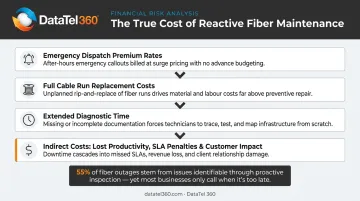
Beyond the downtime exposure — Uptime Institute's data shows 55% of operators experienced an outage in the prior three years — reactive-only approaches carry compounding costs:
- Emergency dispatch rates versus scheduled maintenance rates
- Full cable run replacement when accumulated neglect makes repair impractical
- Extended diagnostic time when documentation is absent or outdated
- Indirect costs: lost productivity, SLA penalties, and customer impact during unplanned outages
What Proactive MRO Prevents
- Connector end-face damage from contamination entering mated interfaces
- Splice degradation that crosses failure thresholds only when bandwidth demands increase
- Accidental damage during future work by trades who encounter unlabeled, undocumented runs
- Emergency labor premiums on calls that scheduled maintenance would have prevented
The FOA does caution that unnecessary disconnection for routine inspection can itself introduce contamination or damage. Qualified MRO programs address this by using documented baselines and condition-triggered testing rather than arbitrary calendar intervals.
What to Look for in a Fiber Optic MRO Partner
Not every telecommunications contractor is equipped for fiber plant MRO. Several criteria separate qualified providers from general IT vendors who handle fiber occasionally.
Field Experience and Proper Tooling
Before committing to a partner, ask specifically about:
- Documented fiber optic project work in commercial environments similar to yours
- Single-mode and multimode experience — many facilities run both, and the diagnostic and repair approaches differ
- Calibrated OTDR equipment, fusion splicers, and fiber inspection microscopes in the field kit
- Technician credentials such as BICSI Installer 2 Optical Fiber or FOA CFOT certification
Credentials are a screening indicator, not a substitute for verifiable field experience and current calibration records.
Response Time and After-Hours Availability
Fiber failures don't follow business hours. A qualified MRO partner should offer:
- Defined response windows for standard issues (same-day or next-day on-site)
- Emergency dispatch for critical outages with 24/7 live support — not voicemail
- Senior engineers accessible on first contact, not Tier-1 helpdesk staff
Single-Source Accountability
Multiple vendors create coordination gaps. When the OTDR testing team, the splice repair crew, and the documentation provider are different organizations, no single party owns the outcome — and your team fills the gaps between them.
DataTel 360 brings more than 25 years of field experience serving businesses throughout Atlanta, Georgia, and the Southeast, with 24/7/365 live dispatch and in-house capability across OTDR diagnostics, fusion splice repair, connector maintenance, and full cable plant documentation. For multi-site organizations, that same model extends nationally through TechDispatch360 field services — one engagement, one point of accountability.
Frequently Asked Questions
How do I know if my fiber optic cable needs repair or full replacement?
OTDR testing determines whether a fault is isolated — repairable by fusion splicing or connector replacement — or whether damage is extensive enough along the run that replacement is more cost-effective. A qualified technician can make that call after reviewing the trace data and assessing physical access.
What causes fiber optic cables to fail in commercial buildings?
Three primary causes: physical stress (bends beyond minimum radius, crushing, or pulling), connector contamination from dust and oils on end-faces, and environmental factors including moisture infiltration, temperature cycling, and rodent damage in warehouse and industrial facilities.
How long does a typical fiber optic repair take?
Connector cleaning or replacement can be completed in under an hour. Fusion splice repairs on accessible runs typically take a few hours including OTDR verification. Conduit work, difficult access, or complex fault localization extend that timeline.
Can fiber optic systems be repaired on-site, or do cables need to be sent out?
Qualified technicians with portable OTDR and fusion splicing equipment perform virtually all commercial fiber repairs on-site. Sending components out adds unnecessary downtime — field repair is faster and gets your system running sooner.
How often should fiber optic systems be inspected and tested?
Annual inspections are a reasonable baseline for most commercial environments. Higher-activity facilities — data centers, manufacturing, healthcare — benefit from more frequent checks, and any construction, renovation, or moves-adds-changes should trigger testing regardless of the scheduled interval.
What is OTDR testing and why does it matter for fiber MRO?
OTDR testing maps the entire fiber run, measures signal loss at each connection point, and pinpoints the exact location of faults by distance. It's the essential diagnostic tool for repair work and the baseline documentation that makes future troubleshooting fast and accurate.