The challenge isn't finding SIP trunking providers. There are dozens of them. The challenge is knowing which evaluation criteria actually separate a reliable enterprise-grade deployment from one that creates more problems than it solves.
The market reflects how seriously organizations are taking this decision: according to Metrigy's 2024 global enterprise study, 46.8% of respondents used SIP trunks with on-premises PBXs, with global SIP trunking revenue reaching $12.4 billion in 2024—up 8.9% year-over-year. Getting the provider selection right from the start matters more than most procurement decisions.
This guide covers the six criteria that consistently separate satisfactory enterprise SIP deployments from ones that generate regret.
Key Takeaways
- Enterprise SIP trunking replaces physical phone lines with internet-based voice channels, scaling up or down without circuit constraints
- Tier 1 carriers resolve issues directly; Tier 2/3 resellers escalate upstream, extending outage duration
- Evaluate total cost of ownership—not just per-minute rates—including setup fees, porting charges, and failover costs
- Security requirements include both TLS (signaling) and SRTP (media)—one does not substitute for the other
- E911 compliance under Kari's Law and RAY BAUM'S Act is site-specific and must be validated for every physical location
What Is Enterprise SIP Trunking?
SIP (Session Initiation Protocol) trunking delivers voice, video, and unified communications over an internet connection, replacing physical PSTN or ISDN lines. It connects an organization's IP PBX to the public telephone network without requiring dedicated copper circuits for each call path.
Enterprise SIP trunking differs from basic SIP deployments in these key ways:
- Supports multi-site deployments with high concurrent call volumes across an entire organization
- Requires contractual SLA backing for mission-critical availability
- Accommodates regulatory configurations for healthcare, financial services, legal, and government environments
- Connects directly to CRM platforms, contact center software, and collaboration tools
- Routes calls through multiple data center termination points with automatic failover
Those distinctions shape the criteria that matter most when selecting a provider. Here's what enterprise organizations gain from making the switch:
Core Benefits for Enterprise Organizations
- Add or remove channels without installing physical circuits or scheduling technician visits
- Carry voice and data over a single connection instead of separate managed circuits
- Support hybrid and remote users without geographic constraints
- Reroute calls automatically to backup paths or mobile numbers during outages
- Replace fixed per-line costs with per-channel pricing tied to actual usage
For compliance-sensitive industries—healthcare, financial services, legal, and manufacturing—SIP trunking isn't just a cost play. It supports encrypted, documented, and auditable call environments that meet regulatory obligations.
What to Consider When Selecting an Enterprise SIP Trunking Provider
Six criteria consistently determine whether an enterprise SIP deployment succeeds or creates ongoing friction. Each one reflects a specific failure mode that organizations encounter when they evaluate providers on price alone.
Network Ownership and Reliability
The most consequential question to ask any SIP trunking provider is whether they own their network or resell capacity from an upstream carrier.
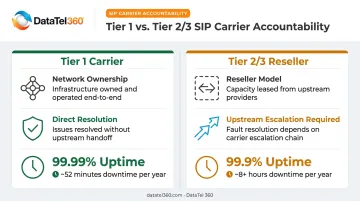
Tier 1 carriers reach the global internet through settlement-free peering agreements and own the infrastructure they operate on. When something breaks, they can act on it directly. Tier 2 and Tier 3 providers buy transit from upstream networks, which means when voice quality degrades or calls fail, their support team opens a ticket with someone else. That accountability gap extends your downtime.
When reviewing SLA terms, look beyond the percentage number. A 99.99% uptime guarantee represents roughly 52 minutes of allowable downtime per year; 99.9% allows over 8 hours. But the availability definition matters as much as the number—what counts as downtime, whether planned maintenance is excluded, and what remedies apply when the SLA is breached all determine whether the commitment has real value.
Ask specifically:
- Do you own your network infrastructure?
- How is availability measured and where?
- What credits apply if uptime targets are missed?
- Do you have redundant routing and automatic failover?
Security and Compliance Support
Enterprise voice security requires two distinct controls that address different parts of the call:
| Control | What It Protects | Standard |
|---|---|---|
| TLS/SIPS | SIP signaling (call setup and teardown) | RFC 5630, TLS 1.3 |
| SRTP | Media (the actual audio) | RFC 3711 |
Requiring only one is insufficient. TLS protects the signaling exchange but does nothing for the voice stream itself; SRTP encrypts media but not the call control layer.
The FCC required STIR/SHAKEN implementation across IP voice networks by June 30, 2021, and removed 185 non-compliant providers from its Robocall Mitigation Database in 2025. Verify that any provider you evaluate maintains a current listing in that database.
For regulated industries, compliance obligations extend further:
- Healthcare: Providers with access to ePHI may qualify as business associates requiring a BAA
- Financial services: FINRA Rule 3170 requires call recording and 3-year retention for designated taping firms
- Government/legal: State-specific data protection and records retention requirements vary
Confirm whether the provider can support compliant configurations and supply documentation suitable for internal audits.
Scalability and Multi-Location Support
Enterprise organizations need channel capacity that adjusts to demand, without requiring on-site visits or multi-week provisioning cycles. Before committing to a provider, verify:
- Capacity scales up or down on demand through a self-service portal
- Separate site configurations can be managed from one centralized interface
- The provider can supply local DIDs across all your operating regions
- Number porting for simple lines completes within one business day under FCC rules, though complex enterprise ports may take longer
E911 compliance deserves specific attention for multi-site deployments. Under Kari's Law, covered systems installed after February 16, 2020 must support direct 911 dialing without a prefix and provide on-site notification.
RAY BAUM'S Act rules require a dispatchable location, meaning the correct physical address routes to the right emergency dispatch center for each site. This must be configured and tested per location, not assumed.
Pricing Transparency and Total Cost of Ownership
Per-minute rates are the least reliable comparison metric in SIP trunking. Two providers advertising similar rates can deliver dramatically different total costs once all variables are factored in.
Metrigy's 2024 data found that 40% of PBX deployments used flat-rate unlimited trunks while 31.7% used metered models. Comparing an unlimited trunk price to a metered trunk price without normalizing for traffic volume produces meaningless numbers.
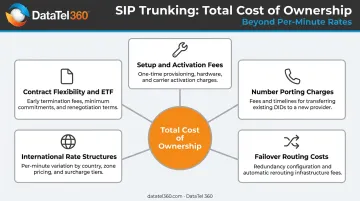
Request fully itemized pricing that covers:
- Setup and activation fees per site or trunk
- Number porting charges for existing DIDs
- Failover routing costs if calls reroute during an outage
- International rate structures if your organization places outbound international calls
- Contract flexibility: month-to-month versus multi-year commitments with early termination penalties
Providers advertising unusually low rates sometimes recover margin through usage overages, restrictive contract terms, or fees that appear only after the agreement is signed. Ask for a fully itemized proposal before any commitment.
PBX and Ecosystem Compatibility
A SIP trunk that doesn't work cleanly with your existing phone system creates problems that range from degraded call quality to broken features like call recording and hunt group routing.
Major platforms have documented SIP trunk configuration requirements:
- Cisco Unified Communications Manager: Supports SIP trunks with up to 16 destination addresses per trunk in Release 15
- Avaya Aura: SIP trunk optimization routes signaling groups through multiple Session Managers
- 3CX: Official documentation covers supported SIP providers and DID routing
- Microsoft Teams: Direct Routing connects a certified Session Border Controller to Teams Phone—Microsoft maintains a certified SBC list
Confirm compatibility before procurement, not after.
Also evaluate whether the provider's SIP implementation supports your contact center software, CRM call logging, or automated workflow integrations. A misconfigured trunk can silently break reporting and data capture that operations depend on.
Support Quality and SLA Commitments
The quality of support is often what determines whether an enterprise stays with a provider or replaces them at renewal. Price matters less than whether someone picks up the phone at 2 AM when calls stop working.
When evaluating support:
- Ask how critical tickets escalate: Who handles a network-level voice outage versus a billing dispute?
- Confirm 24/7 live access: Email-only or chatbot-first models are not adequate for enterprise voice incidents
- Review SLA remedies: What credits or compensation apply for downtime—and does the provider track and report against those commitments automatically?
- Request documented severity levels: Providers that have thought through enterprise support define specific restoration targets for different incident types
Avoid providers that treat support as a cost center. When phones go down, sales calls drop, customer service halts, and every minute of unresolved downtime has a measurable cost—your provider's escalation process should be built with that in mind.
How DataTel 360 Can Help
Selecting the right SIP trunking provider is one decision. Configuring it correctly, coordinating number porting, validating E911 compliance across every location, and integrating it with your existing PBX environment are separate challenges—each with its own technical requirements.
DataTel 360 is an Atlanta-based telecommunications infrastructure partner with more than 25 years of experience helping commercial and enterprise organizations across Georgia, the Southeast, and nationwide select and deploy voice infrastructure.
Rather than representing a single carrier, DataTel 360 operates as a carrier-neutral partner. That means evaluating SIP trunking options across providers to match each client's call volume, compliance requirements, and existing PBX environment.
Key differentiators for enterprise SIP trunking engagements include:
- Vendor-neutral carrier sourcing: No single-provider agenda; recommendations are based on your specific requirements
- Certified platform expertise: Configures SIP trunking on Zultys and Intermedia environments, with experience across other major platforms
- Multi-site deployment capability: Standardized, repeatable rollouts across distributed locations through a single accountable project team
- Nationwide field coverage: Smart Hands and on-site support anywhere in the U.S. via TechDispatch360, with same-day or next-day availability across the Atlanta metro and Southeast
- 24/7/365 live dispatch: Emergency voice outage support handled by live engineers with direct access to your environment
To discuss your SIP trunking requirements, contact DataTel 360 at 770-441-9999 or sales@datatel360.com.
Conclusion
Choosing an enterprise SIP trunking provider is a strategic infrastructure decision, not a commodity purchase. The provider you select affects call quality across every location, compliance posture in regulated business units, operational resilience when connectivity is disrupted, and telecom spend across the full contract term.
The right provider isn't the one with the most feature bullet points or the lowest advertised rate. It's the one whose network ownership model, security capabilities, scalability architecture, and support structure align with what your organization actually requires.
SIP trunking performance also warrants periodic review — not just at deployment. Call quality metrics, SLA adherence records, and channel utilization should be assessed as your business grows and changes. Providers should be held accountable to the commitments documented in their agreements— measured against real usage data, not just contract language.
If you're working through the vendor selection process and need help evaluating SIP trunking options alongside your broader telecom infrastructure, DataTel 360 offers carrier-neutral sourcing and has supported enterprise voice deployments across Atlanta and throughout the Southeast since 1998.
Frequently Asked Questions
What does enterprise trunking mean?
Enterprise trunking refers to high-capacity SIP trunk deployments designed for organizations with significant call volumes, multiple locations, and strict uptime requirements. It typically includes integration with PBX systems, contact center platforms, and compliance-sensitive workflows that standard small-business SIP configurations don't address.
What are SIP trunk providers?
SIP trunk providers are telecommunications companies that deliver voice, video, and messaging connectivity over the internet using Session Initiation Protocol. They range from Tier 1 carriers that own their network infrastructure to Tier 2 and Tier 3 resellers that purchase capacity from upstream carriers and resell it.
Can SIP trunking scale with my business?
SIP trunking is built to scale — channels can be added or removed on demand without hardware changes, and enterprise-grade providers support multi-location expansion without new physical circuits. Confirm your provider handles this through a self-service portal, not a manual provisioning request.
How is enterprise SIP trunking different from standard SIP trunking?
Enterprise deployments involve higher call volumes, multi-site management, stricter SLAs, and compliance configurations—such as site-accurate E911 routing and HIPAA-compatible call handling—that standard small-business SIP trunking doesn't require, along with deeper integration with enterprise communication platforms.
What is a Tier 1 SIP carrier and why does it matter?
A Tier 1 carrier owns its network infrastructure and resolves outages directly. Tier 2 and Tier 3 resellers must escalate to their upstream carriers when problems occur, creating accountability gaps that extend incident duration — a meaningful risk for enterprise voice operations.
What questions should I ask a SIP trunking provider before signing?
Start with these: Do you own your network or resell capacity? What does your uptime SLA cover and what are the remedies? Can you configure E911 for each of our physical locations? What are the complete costs including setup, porting, failover, and international calls? And what does your support escalation process look like for a live voice outage?