The challenge most businesses face isn't finding a contractor — it's understanding why two quotes for the same drop count can differ by 40% or more, and which one actually protects the investment.
This guide breaks down real 2026 commercial cabling costs by tier, explains what drives pricing, and shows you how to build an accurate budget before you engage any vendor.
Key Takeaways
- Commercial network cabling in 2026 is priced per drop, with costs ranging from roughly $100 to $500+ depending on cable type, environment, and complexity
- Labor — not cable — is the dominant cost in any cabling project; building conditions determine how much labor a project requires
- New construction costs significantly less than retrofits — pulling cable before drywall closes is the biggest budget lever
- Cat6A is the current TIA-recommended copper standard for new commercial work; Cat5e is rarely appropriate for new installs
- Physical-layer infrastructure accounts for up to 80% of network downtime — certified installation is a long-term cost decision
How Much Does Network Cabling Installation Cost in 2026?
There is no fixed national rate for commercial network cabling. Pricing is structured around the drop — a single cable run from the telecom room to a wall plate or endpoint device — and per-drop rates shift based on cable category, building conditions, and total project scale.
Most professional cabling firms also carry minimum project thresholds, meaning small jobs are priced to cover mobilization costs regardless of drop count.
Here's how the three main pricing tiers break down for commercial installations in 2026:
Entry-Level Installation ($100–$175 per drop)
This tier covers standard Cat6 cable, open or drop ceiling access, basic wall plates and patch panel termination, and connectivity testing in straightforward new construction or accessible environments.
Best for: Short-term leases, small offices with simple layouts, or businesses with basic gigabit needs and no PoE device requirements. If 10 Gbps capability or dense access point deployments are on the horizon, step up to mid-range.
Mid-Range Installation ($175–$275 per drop)
This tier includes Cat6A cable (plenum-rated where required), certified Fluke testing with documented pass/fail reports, patch panel labeling, and cable management in standard commercial office environments.
Best for: Most growing businesses — particularly offices deploying Wi-Fi 6/7 access points, VoIP phones, or IP cameras. This range covers the majority of professional commercial installations where 10 Gbps future-readiness is a realistic requirement.
High-End/Complex Installation ($300–$500+ per drop)
Complex projects in this range typically require:
- Cat6A or fiber pulls through hard-lid ceilings or conduit
- Scissor-lift access for high bays or elevated pathways
- Core drilling and fire-stopping through rated assemblies
- Full TIA-568.2-E certification with as-built documentation
Best for: Industrial and warehouse environments, multi-floor buildings with concrete construction, healthcare or financial services facilities with compliance requirements, or any project involving difficult routing and long cable runs.
These three tiers establish the baseline — but several project-specific factors can push costs toward the higher end of any range.
Key Factors That Affect Network Cabling Installation Costs
Two projects with identical drop counts can differ by 40% or more based on the variables below. Understanding these before you solicit quotes prevents scope mismatches and budget surprises.
Cable Type and Category
Cable category affects both material cost and long-term network performance:
- Cat5e — Cheapest material cost, but rarely appropriate for new commercial installations; lacks the performance margin for PoE++ or 10 Gbps applications
- Cat6 — Cost-effective for basic gigabit needs; appropriate for low-density environments without heavy PoE loads
- Cat6A — The current TIA-recommended standard for new commercial work; supports 10 Gbps and PoE++ at full 100-meter runs
- Fiber — Required for backbone runs between MDF and IDF rooms, distances over 100 meters, or environments with electromagnetic interference
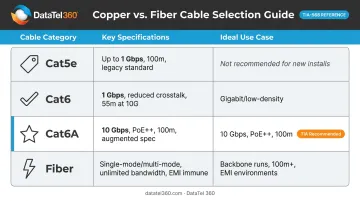
One practical note: while Cat6A materials cost more than Cat6, the total installed cost difference is smaller than most clients expect. Labor is the dominant expense. Upgrading the cable category rarely doubles the project cost — but re-cabling because the original spec was underpowered often does.
Building Type and Installation Environment
Building construction is the largest labor variable in any cabling project:
- Open drop ceilings — Standard in modern office buildings; allow fast, efficient cable routing with straightforward access
- Hard-lid or concrete ceilings — Require surface conduit, core drilling, or wall fishing; add significant labor hours per run
- Retrofit in occupied buildings — Involves working around existing infrastructure, insulation, and limited access points; increases both time and complexity
- Warehouse and industrial environments — Add scissor-lift rental, EMI-rated shielded cabling, environmental-grade materials, and operational scheduling constraints (often requiring after-hours or weekend installations)
Project Scale and Number of Drops
Per-drop cost decreases as total drop count increases. A 10-drop project carries proportionally higher overhead per drop than a 100-drop project because mobilization costs — crew time, equipment transport, setup — are spread across more units.
This is why small projects often surprise clients with higher-than-expected per-drop rates. Most professional cabling firms have minimum project thresholds that small jobs must meet regardless of scope.
Labor Rates and Geographic Location
Labor consistently represents the majority of total project cost. Rates vary by technician experience, project complexity, and local market conditions.
BLS wage data for telecommunications equipment installers shows meaningful geographic variation: the national mean hourly wage is $30.77, Atlanta sits at $31.27, and San Francisco reaches $41.76. These are technician wages — contractor billing rates are higher — but the regional gaps reflect real market differences. Southeast US markets like Atlanta generally offer competitive rates compared to major coastal metros.
After-hours or weekend installations, often necessary to avoid disrupting business operations, typically carry a labor premium above standard rates. DataTel 360 operates on a 24/7/365 dispatch model and routinely handles after-hours cutovers for occupied commercial environments across Atlanta and the Southeast.
New Construction vs. Retrofit Timing
New construction is the single biggest cost-saving opportunity in any cabling project. Installing cable before drywall goes up eliminates wall fishing, reduces routing complexity, and cuts labor hours significantly compared to retrofitting a finished space.
The most effective approach sequences telecom infrastructure during the build phase so connectivity is ready on day one. DataTel 360 coordinates directly with general contractors on new builds for exactly this reason — avoiding the rework costs that come with late-stage cabling.
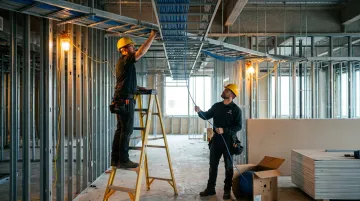
That timing advantage also applies to existing infrastructure. Legacy cabling (Cat5e or uncertified Cat6 without documented test results) is not a reliable foundation for modern deployments. Without verified test data, there's no way to confirm the cable will support current performance requirements. Budget for a complete new pull rather than assuming legacy infrastructure can carry the load.
Full Cost Breakdown: What You're Actually Paying For
The per-drop price is only part of the story. Total project cost includes several components that don't always appear in the headline number:
| Cost Component | What It Covers |
|---|---|
| Cable materials | Per-foot cost by category; plenum-rated (CMP) cable carries a premium over riser (CMR) for drop ceiling environments |
| Hardware | Wall plates, keystone jacks, patch panels, cable management, rack infrastructure |
| Labor | Installation, termination, and certification — the majority of total project cost |
| Permits and inspections | Fees vary significantly by jurisdiction; Franklin, WI charges $1.25 per device with a $125 commercial minimum; Cape Coral, FL lists a $165 base fee for commercial low-voltage work — always budget from the actual jurisdiction |
| Testing and certification | Fluke DSX or equivalent certified testing required for manufacturer warranty compliance |
| Contingency | Professional quotes should include a buffer for unexpected routing challenges or scope changes |
What Standard Per-Drop Quotes Typically Exclude
Be specific with vendors about these items — they can add meaningful cost if not scoped upfront:
- Conduit installation (surface or in-wall)
- Fire-stopping penetrations through rated assemblies
- Drywall patching after retrofit work
- Network switch or active equipment procurement
Budget vs. Professional-Grade Installations
Those excluded scope items are also where budget bids tend to cut corners. Lower bids frequently reflect skipped Fluke certification, Cat5e or uncertified Cat6 instead of Cat6A, or crews without structured cabling training. The upfront cost difference between a budget and professional-grade installation is less than the cost of re-cabling or troubleshooting failures within a few years.
DataTel 360 includes Fluke-certified copper testing, labeled panels, as-built drawings, and photographic documentation as standard deliverables on every project — built into the scope, not priced separately at the end.
What Most Businesses Get Wrong About Network Cabling Costs
Comparing price instead of scope
Two quotes for the same drop count can look very different. The cheaper one typically skips certified testing, uses lower-spec cable, or excludes hardware that the other quote includes. The only valid comparison is scope vs. scope — not just the bottom-line number.
Underestimating future growth
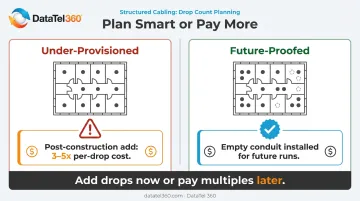
Adding a single drop to a finished commercial space after walls are closed costs multiples of what it costs during the initial pull. The practical guidance used across the industry — provisioning 20–30% more drops than current headcount requires and installing empty conduit for future runs — exists precisely because hindsight is expensive in cabling projects.
Ignoring long-term quality costs
Physical infrastructure accounts for up to 80% of network downtime according to Fluke Networks, citing multiple studies. Skipping certified testing doesn't reduce project cost — it transfers that cost to future troubleshooting, downtime, and eventual re-cabling.
Certified installations from major manufacturers require approved components, certified installers, and validated testing — and come with warranties that reflect that standard:
- Belden — 25-year product warranty
- Panduit — 15, 20, or 25-year system warranties depending on program tier
- CommScope — 25-year extended product and application warranty
A warranty at this level means the infrastructure is built to last that window without re-cabling. That's the real cost comparison: a lower bid today versus a full redo in five years.
How to Estimate Your Network Cabling Budget
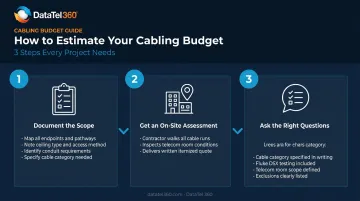
Step 1: Document the project scope
Before engaging any vendor:
- Map the floor plan and identify every endpoint (workstations, IP phones, access points, cameras, printers) as a separate drop
- Note the building construction type (open ceiling, hard-lid, concrete)
- Identify any areas requiring conduit, elevated access, or special routing
- Specify the cable category needed (Cat6A for most new commercial work)
Step 2: Get an on-site assessment
Over-the-phone or sight-unseen estimates are unreliable. The only accurate number comes from a contractor who walks the building and delivers a written scope with itemized pricing.
A qualified contractor should walk every run, inspect the telecom room, and return with a written quote tied to actual building conditions — not phone-call guesses. DataTel 360 provides on-site assessments for commercial projects across Atlanta and the Southeast, with written scopes and Fluke-certified installations backed by 25+ years of field experience.
Step 3: Ask the right questions before signing
Any cabling contractor should be able to answer these clearly:
- What cable category is being specified? (Cat6A should be the answer for new commercial work)
- Is certified Fluke DSX testing included with documented pass/fail reports?
- What does the telecom room scope include — patch panels, cable management, rack infrastructure?
- What is explicitly excluded from this bid?
If a contractor can't answer these directly, request written clarification before signing anything.
Conclusion
Commercial network cabling costs in 2026 range from roughly $100 to $500+ per drop based on cable category, building conditions, project scale, and whether the work is new construction or a retrofit. Knowing that range is useful; knowing which variables push your project toward one end or the other is what makes a budget realistic.
The right installation isn't the cheapest one. It's the one built to TIA-568.2-E standards, certified with documented test results, and backed by manufacturer warranties that protect the investment for 15 to 25 years. Certification documentation also gives you proof of performance — something uncertified work simply can't provide if problems surface later.
Getting those details right starts with an on-site assessment from a contractor who's done it across Atlanta and the broader Southeast. DataTel 360 can walk through your space, identify the variables that affect your specific project, and give you a number you can actually plan around. Reach out at 770-441-9999 or sales@datatel360.com to schedule an on-site assessment.
Frequently Asked Questions
How much does it cost to install a network cable?
Commercial network cabling in 2026 typically ranges from $100 to $500+ per drop, depending on cable category, building conditions, and project complexity. Each drop includes the cable run, terminations at both ends, wall plate, patch panel port, and certified testing. Total cost scales with drop count, site conditions, and any required after-hours access.
How much does a network cable cost?
Labor is the dominant cost on commercial cabling projects — materials are a minority of the all-in per-drop price. Cat5e is the cheapest copper option; Cat6A costs more per foot but is the recommended standard for new commercial work. Fiber varies by type and run length.
What cable type is best for commercial network cabling in 2026?
Cat6A is the TIA-recommended standard for new commercial copper installations. It supports 10 Gbps at full 100-meter runs, handles PoE++ loads without the heat buildup issues that affect Cat6 in dense deployments, and qualifies for manufacturer extended warranties. Fiber is the right choice for backbone runs between telecom rooms or distances exceeding 100 meters.
Do I need permits for commercial network cabling installation?
Most commercial low-voltage installations require permits, though fees and requirements vary significantly by municipality. Always confirm requirements with the local Authority Having Jurisdiction (AHJ) before project start, and verify your contractor is licensed for low-voltage work in your state.
How long does a commercial network cabling installation take?
Small offices (5–15 drops) typically complete in one to three days. Mid-size projects (50–100 drops) often require one to two weeks. Larger or more complex installations can take several weeks, with additional lead time needed for permit approvals or after-hours scheduling in occupied buildings.
How can I reduce the cost of my network cabling project?
Four strategies consistently reduce project cost:
- Install during new construction or active renovation when walls are open
- Bundle cabling with other low-voltage work to reduce mobilization costs
- Specify the correct drop count upfront — post-construction additions are expensive
- Get multiple written quotes with fully itemized scopes so you're comparing equivalent work