Introduction
Many Atlanta-area businesses are still running phone systems built around a single physical location — wired desk phones, fixed extensions, and no way to support a remote employee or a second office without a costly workaround. When someone works from home or a new site opens across town, calls get missed, transfers fail, and IT scrambles to patch together a solution that was never designed for it.
Intermedia Hosted PBX addresses this by replacing that aging hardware with a cloud-based VoIP telephone service — one that works from virtually any device or location without requiring a separate system at each site.
This guide covers what Intermedia Hosted PBX is, how VoIP technology works underneath it, the key features you can expect, and how to evaluate whether it's the right upgrade for your organization. You'll also learn the differences between PBX types and what a real migration looks like from start to finish.
Key Takeaways
- Intermedia Hosted PBX is a cloud-based VoIP system — no on-site hardware required
- Remote, hybrid, and multi-location teams connect via desk phones, desktop apps, or mobile devices
- Flat-rate per-user pricing replaces unpredictable per-line telecom charges
- Features include auto-attendants, voicemail with transcription, hunt groups, and CRM integrations
- A certified Intermedia partner like DataTel 360 brings 25+ years of field experience and 24/7 support to your deployment
What Is Intermedia Hosted PBX?
PBX, Defined
A Private Branch Exchange (PBX) is a private internal telephone network. It lets employees reach each other through extensions while sharing a smaller pool of external lines for outside calls. Traditionally, this meant a physical switching unit installed somewhere in your building — often in a dedicated telecom room.
With hosted PBX, the provider manages all switching infrastructure in the cloud. Your business gets the same private telephone network — no hardware to purchase, no servers to maintain, and no telecom room required.
VoIP as the Delivery Mechanism
Intermedia Hosted PBX is VoIP-based, meaning calls travel over your broadband internet connection rather than copper phone lines. According to the FCC, VoIP allows voice calls using a broadband internet connection instead of a regular analog line. That shift enables HD audio clarity, voicemail-to-email delivery, and auto-attendant routing — features that traditional analog lines don't support.
Intermedia Unite: The Platform Behind It
The modern delivery vehicle for Intermedia Hosted PBX is Intermedia Unite — a unified cloud communications platform that packages voice calling alongside HD video conferencing, team chat, and business SMS. Businesses that only need to upgrade their phone system can start with the hosted PBX component without adopting every other feature at once.
DataTel 360 holds Intermedia Solutions Expertise certification, meaning their technicians design, configure, and deploy Unite environments for commercial clients across Atlanta and the Southeast — not just resell licenses.
How Intermedia Hosted PBX Uses VoIP
How VoIP Replaces Traditional Phone Lines
VoIP converts your voice into digital data packets and transmits them over a broadband connection. This replaces the analog signals that travel through copper wiring in traditional PSTN (Plain Old Telephone Service) networks.
The practical differences matter for business:
- Analog PSTN lines are single-location, low data-rate, and typically billed per line
- VoIP over broadband supports remote access, HD audio (ITU-T G.722 wideband codec covers 50–7,000 Hz versus narrowband's 300–3,400 Hz), and consolidates calling costs under flat-rate pricing
- Copper infrastructure is declining — AT&T has announced that traditional copper-wire service is being phased out in favor of fiber and alternative technologies, making VoIP migration increasingly urgent for businesses still on legacy lines
That infrastructure shift is exactly why cloud-based call management has become the standard for modern business phone systems.
How Calls Are Managed in the Cloud
When a caller dials your main business number, a cloud-based switch handles everything:
- The call arrives at Intermedia's cloud infrastructure
- An auto-attendant greets the caller and presents menu options
- The system routes the call to the appropriate extension, department, or device
- The employee receives the call on a VoIP desk phone, desktop app, or mobile device
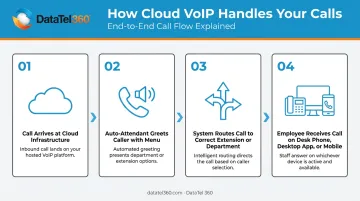
No physical switching equipment sits in your office. The entire routing process happens in Intermedia's cloud, which means employees in different buildings — or different cities — all operate on the same system.
Device flexibility is one of the biggest practical advantages. Users can answer calls on:
- A VoIP desk phone connected to a standard router port
- A softphone application on a Windows or Mac computer
- The Intermedia Unite mobile app on Android or iOS
Key Features of the Intermedia Hosted PBX VoIP Service
Call Routing and Auto-Attendant
The auto-attendant greets callers with a customized message and routes them based on their menu selection — to sales, support, a specific extension, or a department. This reduces reliance on a live receptionist for basic call handling.
Hunt groups extend this further. Incoming calls can ring across a group of employees simultaneously or sequentially until someone picks up. During peak hours, this prevents important calls from going unanswered because one person stepped away.
Voicemail and Call Management Tools
Voicemail with transcription converts messages to text and delivers them to a user's inbox — no dialing into a voicemail system required. Employees can review, forward, or archive messages directly from email.
User call forwarding lets employees designate backup numbers — a mobile phone, a home office line — that ring automatically when their primary line goes unanswered. Clients dial one number; the system locates the right person automatically.
Productivity and Collaboration Features
Intermedia Unite's QoS Dashboard and Call History give administrators visibility into call volumes, durations, and patterns — useful for identifying gaps in customer service coverage or evaluating team responsiveness.
CRM integrations connect the phone system to existing business tools, reducing manual data entry and logging call activity automatically inside the platforms your team already uses.
The system also includes standard business calling tools:
- Extension dialing, call transfer, call waiting, and 3-way calling
- Caller ID and SPAM call blocking/tagging
- Music on hold and custom hold greetings
- Emergency Services Notification (E911)
- Basic and Advanced Hunt Groups
The Three Types of PBX Systems Explained
Not all PBX systems work the same way. Here's how the three main types compare, so you can evaluate what fits your business — and what you might be moving away from.
| PBX Type | How It Works | Best For |
|---|---|---|
| Hosted (Cloud) PBX | Provider manages all infrastructure in the cloud; businesses access calling over the internet | Businesses prioritizing flexibility, low upfront cost, and scalability |
| On-Premise PBX | Switching hardware lives at the business location; company manages maintenance and upgrades | Organizations requiring maximum in-house control and with IT resources to manage it |
| Hybrid PBX | Existing on-premise system connects to cloud services via SIP trunking | Businesses with legacy hardware investment they're not ready to fully retire |
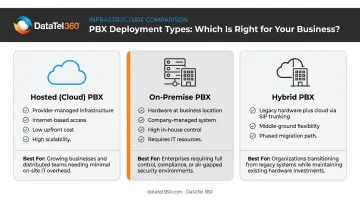
Hosted PBX goes by several names — virtual PBX, cloud PBX, IP PBX — but they all describe the same model. Scaling up means adding a software license, not ordering hardware.
The hybrid approach uses SIP (Session Initiation Protocol) trunking, which carries voice traffic between an existing on-premise system and cloud services over virtual IP connections. It's a practical middle step for businesses that want VoIP benefits without committing to a full migration right away.
Top Benefits of Intermedia Hosted PBX for Businesses
Predictable Costs Without Hardware Investment
Hosted VoIP eliminates the upfront hardware purchase, the maintenance contracts, and the per-line charges that come with traditional systems. Intermedia Unite is priced at $27.99/user/month (Pro) or $32.99/user/month (Enterprise), with unlimited domestic calling in the US and Canada included. That means one predictable line item per employee, per month — no surprise invoices from the carrier.
Businesses also shed the cost of maintaining aging PBX hardware. As TechTarget notes, cloud PBX places infrastructure management and updates with the provider rather than the customer.
Reliability and Business Continuity
Intermedia's contractual Service Level Agreement commits to 99.999% Network Availability and 99.999% Cloud Voice Availability per calendar month. Under the SLA, that's less than six minutes of potential downtime per year.
When an outage does occur on the local network side, Intermedia's failover routing automatically redirects inbound calls to an alternate number — keeping operations running even if the office internet goes down temporarily.
Scalability Without the Logistics
Adding a new employee to the phone system doesn't require a technician visit, hardware procurement, or wiring. Cloud-PBX administrators can add, change, or remove users through a web interface. For multi-location businesses, a new office joins the same phone system the same day access is set up.
This is particularly relevant for Atlanta-area businesses expanding across multiple locations, or any organization that scaled up remote workers quickly and now needs a phone system built for distributed teams — not improvised around them.
How to Get Started with Intermedia Hosted PBX
Assess Your Current Setup
Before any migration conversation, take stock of what you're working with:
- How many users and locations need phone service?
- What internet bandwidth is available at each site? (VoIP call quality depends on consistent, low-latency broadband)
- Do you have existing VoIP handsets that might carry over, or is this a full hardware refresh?
- What call flows, extensions, and auto-attendant menus does the current system handle?
This audit shapes everything — system design, hardware decisions, porting timelines, and training scope.
Choose a Certified Intermedia Partner
Self-provisioning a hosted PBX system is possible, but it rarely goes smoothly for businesses with more than a handful of users. A certified partner handles the highest-risk pieces: number porting, call flow configuration, device setup, and user training.
DataTel 360 holds Intermedia Solutions Expertise certification and has served Atlanta-area businesses and multi-location enterprises since 1998. From system design through post-go-live support, their team manages the entire deployment as a single accountable partner. For businesses with offices across Georgia or nationally, DataTel 360 extends field support through TechDispatch360, their nationwide dispatch platform.
Because DataTel 360 also handles structured cabling, network infrastructure, and VoIP simultaneously, they can assess and address the physical network layer — cabling, switches, PoE, VLANs — as part of the same engagement rather than treating it as a separate project.
Plan for Migration
A typical migration covers these five phases:
- Number porting — transferring existing business phone numbers to the new platform
- Call flow design — mapping auto-attendant menus, hunt groups, and extension assignments
- Device configuration — provisioning desk phones, desktop apps, and mobile access
- User training — ensuring staff know how to use voicemail, call forwarding, and the softphone app
- Pre-go-live testing — verifying every extension, route, and feature before cutting over
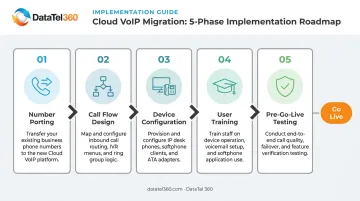
The goal is a clean cutover — the system works correctly on day one, business numbers stay the same, and customers experience no disruption. With DataTel 360 managing the process, one team owns every phase — from porting through training — so there's no finger-pointing if issues arise before or after go-live.
Frequently Asked Questions
What does hosted PBX mean?
Hosted PBX is a cloud-based private telephone network where the service provider manages all switching hardware off-site. Businesses access calling features over the internet without needing any on-premise switching equipment or telecom servers.
Is Intermedia Unite VoIP?
Yes. Intermedia Unite is a VoIP-based unified communications platform that delivers voice calling, HD video, team chat, and business SMS over the internet. The hosted PBX capability is the phone system component within this broader cloud communications suite.
Are PBX systems still used?
PBX systems are still widely used, but the market has largely shifted from on-premise hardware to cloud-hosted VoIP. MarketsandMarkets forecasts the hosted PBX market to reach $24.9 billion by 2028, reflecting strong and sustained adoption growth.
What are the three types of PBX?
The three types are hosted (cloud) PBX, on-premise PBX, and hybrid PBX. Hosted runs entirely in the cloud, on-premise keeps hardware at the business location, and hybrid connects legacy on-site equipment to cloud services via SIP trunking.
What is the difference between Intermedia Hosted PBX and a traditional phone system?
Traditional systems rely on physical hardware and copper phone lines at the business location. Intermedia Hosted PBX runs in the cloud over VoIP, eliminating hardware costs and enabling remote access, auto-attendants, and call analytics that traditional systems can't match.
How long does it take to set up an Intermedia Hosted PBX system?
Cloud-based deployment is significantly faster than on-premise installation. A certified partner like DataTel 360 can typically configure and go live within days — compared to the weeks a hardware-based system would require.