Introduction
Picture this: a physician is mid-consultation with a remote specialist when the video call drops. A nurse sends an urgent alert through the call system, but the network is congested and the response is delayed. Meanwhile, the front desk can't access the EHR because the Wi-Fi just went down in the east wing.
None of these failures make headlines. But each one slows care, frustrates staff, and in the worst cases, contributes to clinical errors.
Modern healthcare facilities depend on telecom infrastructure for far more than basic phone service. Every EHR login, telehealth session, medical image transfer, and nurse call flows through the same underlying network. When that network is poorly designed or inadequately maintained, the consequences are both operational and clinical.
This guide covers the full scope of what healthcare facilities need from a telecom provider: connectivity infrastructure, VoIP and unified communications, wireless networking, telehealth support, HIPAA compliance, and how to choose the right partner.
Key Takeaways
- Telecom providers are foundational to healthcare operations — not a commodity utility
- Healthcare settings require specialized infrastructure: VoIP, structured cabling, fiber, and secure wireless
- HIPAA compliance is non-negotiable for any telecom solution handling patient data
- The right partner reduces downtime, supports telehealth, and improves care coordination
- Single-source partners resolve issues faster and provide clearer accountability
Why Telecom Infrastructure Is Critical to Healthcare Operations
Healthcare facilities run critical applications around the clock — EHR platforms, patient monitoring systems, nurse call networks, medical imaging (PACS/DICOM), VoIP communications, and telehealth platforms. Every one of these depends on reliable, high-bandwidth connectivity. A network outage isn't an inconvenience. It's a care delivery failure.
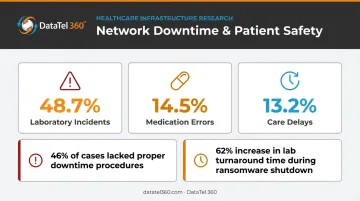
Research published in the Journal of the American Medical Informatics Association analyzed 76 downtime-related safety incident reports across nearly 80,000 submissions. Laboratory events accounted for 48.7% of those incidents, medication administration errors for 14.5%, and general care delays for 13.2%. In 46% of cases, proper downtime procedures were absent or not followed.
A ransomware-related hospital shutdown documented in the same literature showed laboratory turnaround times delayed by an average of 62% — roughly 20 minutes per test under measured conditions, with staff interviews indicating real-world delays that stretched into hours.
The Communication Flow Healthcare Depends On
A typical healthcare day involves dozens of simultaneous, interdependent communication streams:
- Clinical staff coordinating care across departments and floors
- Physicians consulting remote specialists via video
- Administrative teams handling scheduling, insurance verification, and billing
- Patients communicating with providers through portals and telehealth platforms
- Medical devices transmitting continuous monitoring data over the network
Each touchpoint requires stable, well-engineered infrastructure. When one layer fails, downstream workflows fail with it — from delayed lab results to dropped telehealth sessions.
The Shift to IP-Based Healthcare Environments
The transition from traditional landline-dependent facilities to IP-based, cloud-connected environments has expanded both the capabilities and the complexity of healthcare telecom. Modern facilities can support real-time coordination across campuses and clinics, real-time remote consultations, and cloud EHR access from any device. But that same interconnectedness means a poorly configured network creates more failure points, not fewer.
That complexity is exactly why vendor selection matters. Healthcare environments carry compliance obligations under HIPAA, strict uptime expectations tied to patient safety, and clinical workflows that generic commercial IT providers rarely understand in practice. The infrastructure contractor needs to know what a nurse call system failure means at 2 a.m. — not just how to terminate a Cat6A run.
Core Telecom Services That Support Healthcare Facilities
Structured Cabling and Fiber Optic Infrastructure
The physical cabling backbone underpins everything in a healthcare facility. Structured cabling connects medical devices, workstations, nurse call systems, imaging equipment, and servers into a coherent, manageable network.
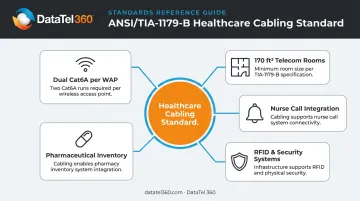
ANSI/TIA-1179-B, released in 2023, is the governing standard for healthcare facility cabling. It specifies:
- Two Category 6A-or-better runs per wireless access point — supporting the high-density wireless environments healthcare facilities require
- Minimum telecom room dimensions (16 m²/170 ft²)
- Topology, distance, pathway, and space requirements specific to clinical environments
The standard covers not just IT systems but also nurse call, RFID, security, access control, and pharmaceutical inventory systems. This scope reflects how much cabling must carry in a clinical environment.
For imaging-heavy environments, cabling infrastructure must also support high-volume PACS and DICOM transfers. The appropriate capacity depends on modalities in use, peak concurrent transfers, and PACS server location. That's why proper healthcare cabling is designed from actual facility data, not generic assumptions.
DataTel 360 installs Cat6A copper cabling and both single-mode and multimode fiber, with all copper runs Fluke-certified and all fiber OTDR-tested. Every project includes labeled panels and as-built drawings — documentation that is essential in regulated healthcare environments.
Internet Connectivity and Bandwidth Management
Clinical environments have connectivity requirements that consumer-grade internet simply cannot meet. Healthcare facilities need:
- Symmetrical bandwidth sized for concurrent EHR access, video consultations, cloud applications, and medical device traffic
- Redundant connections from diverse carriers and physical paths
- Tested failover that activates automatically, not after a tech call
- QoS configurations that prioritize clinical traffic over general-purpose use
HHS ASPR TRACIE recommends that backup communication systems be based on established best practices and tested regularly — including alternatives that don't depend on terrestrial telecommunications infrastructure.
Enterprise Wi-Fi Design
Healthcare Wi-Fi isn't a plug-and-play deployment. Clinical environments present specific challenges:
- Dense concrete walls, elevator shafts, and metal structures create RF interference
- Medical IoT devices, telemetry equipment, and wireless workstations compete for spectrum
- The FCC's Wireless Medical Telemetry Service reserves protected spectrum (608–614 MHz, 1395–1400 MHz, and 1427–1432 MHz) to reduce interference with patient monitoring systems
A proper healthcare Wi-Fi deployment starts with a formal RF site survey, includes access point placement based on actual signal mapping, and is validated for roaming performance across mobile workstations and clinical carts. DataTel 360 conducts site surveys as a standard step in all Wi-Fi deployments, mapping actual coverage and interference before placing a single access point.
Nurse Call Systems and Paging Integration
Nurse call systems, overhead paging, and staff communication platforms must integrate into the broader network without interference or delay. These systems carry life-safety communications — they require the same engineering rigor as any other clinical infrastructure.
DataTel 360's healthcare infrastructure engagements include nurse call and paging integration as a standard scope item, covering:
- Network integration with existing cabling and switching infrastructure
- Coordination with nurse call system vendors for proper signal and power pathways
- Testing and documentation per clinical commissioning requirements
VoIP, Unified Communications, and Healthcare Phone Systems
Why Healthcare Facilities Are Moving to VoIP
Traditional PBX systems are being replaced by VoIP and cloud-based unified communications across the healthcare sector . Cloud VoIP offers:
- Lower total cost than maintaining legacy hardware
- Scalability across multiple locations without adding physical infrastructure
- Advanced call management including auto-attendants, call routing, and voicemail-to-email
- Integration with EHR and scheduling platforms
- Resilience — calls continue routing even if a single location loses connectivity
The transition does require a well-configured underlying network. VoIP is sensitive to latency, jitter, and packet loss — which is why a clean cabling infrastructure and proper QoS settings are prerequisites for consistent call quality.
Unified Communications in Clinical Environments
Cloud-based unified communications (UC) platforms consolidate voice, video, messaging, and collaboration into a single system accessible from any device or location. For healthcare, this means:
- Physicians can place calls, message colleagues, and join video consultations through one platform
- On-call staff stay reachable from anywhere, not just a desk phone
- Specialist consultations move faster without depending on overhead paging
DataTel 360 is certified in both Zultys and Intermedia — platforms that offer healthcare-ready UC solutions suited to multi-provider and multi-location environments. Both platforms support call recording, integrated voicemail, auto-attendant routing, and the kind of advanced call management that clinical operations require.
Healthcare-Specific Phone System Requirements
A properly configured healthcare phone system handles several compliance and operational needs automatically:
- Routes after-hours calls to on-call staff without manual forwarding
- Records calls automatically for documentation and compliance
- Supports directory-based dialing across large, multi-department facilities
- Restricts voicemail access with configurable access controls
A 2021 KLAS clinical communications study found that 100% of interviewed organizations reported improved communication efficiency after adopting modern UC platforms, with measured outcomes including faster collaboration, quicker diagnoses, and improved responses to critical alerts.
24/7 Support for Around-the-Clock Operations
Reliable communications infrastructure only matters if someone is available to fix it when it fails. Healthcare doesn't run on business hours. DataTel 360 provides 24/7/365 emergency support with an average response time under 15 minutes for critical phone system failures — including VoIP outages, fiber cuts, and network failures. Same-day on-site dispatch is available within service areas, with nationwide coverage through TechDispatch360 for multi-location healthcare accounts.
Telehealth Infrastructure, Security, and HIPAA Compliance
Telehealth Infrastructure Support
Telehealth is no longer an emerging feature — it's a standard care delivery channel. CDC data show that 80.5% of U.S. office-based physicians used telemedicine in 2021, while the AHA reports 86.9% of hospitals offered telehealth services in 2022.
That adoption level means facilities must plan for concurrent clinical video sessions, not a single occasional call. Each high-definition telehealth session requires sufficient dedicated bandwidth and network conditions that support:
- Latency at 150 ms or less
- Packet loss at 2% or less
- QoS policies that prioritize clinical video over general internet traffic
Telecom providers enable telehealth by supplying the underlying connectivity, network configurations, and WAN infrastructure that these platforms depend on. For multi-site healthcare networks — connecting a primary care clinic to a specialist at a hospital — reliable WAN connections with tested failover are essential for real-time clinical data sharing.
Security and HIPAA Compliance
Any technology that transmits, stores, or processes Protected Health Information (PHI) must meet HIPAA's Security and Privacy Rules. This includes phone calls, voicemails, video consultations, and the data networks carrying them.
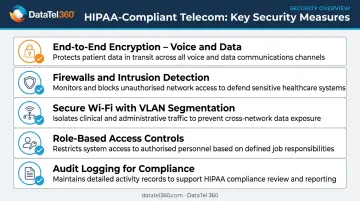
Key security measures a HIPAA-compliant telecom provider must implement:
- End-to-end encryption for voice and data
- Network firewalls and intrusion detection systems
- Secure Wi-Fi configurations with proper VLAN segmentation
- Access controls limiting PHI exposure by role
- Audit logging for compliance documentation
Network servers were identified as the location of data in 66% of large breach reports in 2023 and 63% in 2024, according to HHS Office for Civil Rights data. That's not evidence that telecom providers caused those breaches — but it does underscore why network architecture, segmentation, and access controls matter enormously.
The Business Associate Agreement (BAA) is the contractual anchor of HIPAA compliance for telecom vendors. Under HHS guidance, any provider that stores or persistently accesses ePHI — beyond simple transmission — is generally classified as a Business Associate, not a conduit.
That classification requires a signed BAA defining permitted uses, required safeguards, breach reporting obligations, and termination rights. Healthcare facilities should verify BAA availability before signing any telecom contract.
Satisfying those contractual obligations also requires the right technical architecture. Network segmentation is a foundational design requirement in clinical environments: VLANs separate clinical traffic from administrative and guest networks, isolating patient data from general-purpose internet use and enforcing access boundaries between departments. DataTel 360 builds VLAN segmentation into enterprise network deployments as standard practice, with separate treatment for voice, data, guest, and security traffic.
Choosing a Telecom Partner for Your Healthcare Facility
What to Look for in a Healthcare Telecom Provider
Healthcare decision-makers evaluating telecom partners should apply a specific set of criteria:
- Healthcare-specific experience — not just general commercial IT
- HIPAA compliance capability and willingness to sign a BAA
- Broad service portfolio — cabling, connectivity, phone systems, and networking under one roof
- Response time guarantees — with documented SLA commitments
- Local or on-site support — particularly for critical system failures
- Vendor-neutral recommendations — so the provider recommends what's right, not what pays the highest margin
A single-source partner eliminates the inter-vendor blame cycle that slows resolution when something goes wrong. When a network outage affects both EHR access and VoIP simultaneously, one call to one team with full institutional knowledge of the infrastructure resolves the issue faster than coordinating three separate vendors who each own only a piece of it.
DataTel 360 serves as this type of single-source partner for healthcare facilities in Atlanta, the Southeast, and nationwide — with 24/7 emergency support, same-day or next-day on-site response, and a vendor-neutral approach across all technology decisions.
Scalability and Future-Readiness
Healthcare organizations grow, merge, add locations, and adopt new technologies. AI-assisted diagnostics, remote patient monitoring, and expanded telehealth capabilities all place new demands on existing infrastructure. The right telecom partner designs systems that scale with the organization — not systems that hit a ceiling when a new wing opens or a new platform rolls out.
Multi-location rollouts add another layer of complexity — each site needs standardized infrastructure design deployed consistently across distributed facilities. DataTel 360's TechDispatch360 field services model is built for exactly this, extending nationwide coverage for healthcare accounts that have grown beyond a single location.
Questions to Ask a Prospective Telecom Partner
Before signing a contract, ask:
- Do you have documented experience in healthcare environments?
- Will you sign a Business Associate Agreement?
- Are your recommendations vendor-neutral?
- What are your uptime and response time guarantees?
- Do you offer proactive network monitoring and managed services?
- Can you support standardized rollouts across multiple locations?
Frequently Asked Questions
What telecom services do healthcare facilities need most?
Core needs include reliable internet connectivity, structured cabling and fiber backbone, VoIP or cloud phone systems, enterprise Wi-Fi, and secure network management with VLAN segmentation. The specific mix depends on facility size, number of locations, and clinical applications in use.
How do telecom providers ensure HIPAA compliance in healthcare settings?
HIPAA-compliant providers implement encryption, access controls, firewalls, and audit logging. They should also sign a Business Associate Agreement acknowledging their role in handling or transmitting PHI. Verify these capabilities and get the BAA in writing before deployment begins.
What is the difference between VoIP and a traditional phone system for healthcare?
VoIP uses internet-based connections rather than copper phone lines, offering lower cost, greater flexibility, advanced call management, and easier integration with EHR and scheduling platforms. It does require a well-configured network with proper QoS to maintain consistent call quality.
How does poor telecom infrastructure affect patient care?
Network outages and unreliable wireless coverage create real clinical consequences: delayed care coordination, disrupted telehealth sessions, slow access to patient records, and degraded nurse call response times. Each of these gaps increases the risk of care errors and patient dissatisfaction.
Can a telecom provider support telehealth and remote patient monitoring?
Yes. Telecom providers supply the connectivity, bandwidth, and QoS configurations that telehealth platforms and remote monitoring devices require to function reliably. Multi-site WAN design is also essential for facilities connecting patients to off-site specialists.
What should a healthcare facility look for when selecting a telecom partner?
Look for a partner with proven healthcare experience, HIPAA compliance capability, and vendor-neutral sourcing. Fast on-site support and a broad service portfolio matter too — a single-source contractor delivers faster resolution and clearer accountability than juggling multiple specialized vendors.