Introduction
Unplanned downtime carries a steep price tag. According to Uptime Institute's annual outage analysis, 57% of respondents reported that their most recent major outage cost more than $100,000, with one in five exceeding $1 million. For businesses running on-premises or co-located IT infrastructure, those aren't abstract figures — they represent lost revenue, halted operations, and damaged client relationships.
A structured maintenance and support program is what separates organizations that absorb those costs from those that avoid them. This guide covers everything IT managers and business owners need to know: the types of maintenance available, the core services a solid program includes, best practices to follow, and how to evaluate a support partner.
Key Takeaways
- 57% of major data center outages cost over $100,000 — unplanned downtime is a financial event, not just an operational one
- The strongest programs combine proactive maintenance with reactive support — one without the other leaves gaps
- Power issues drive over half of all significant outages, making power system maintenance non-negotiable
- Detailed asset documentation dramatically reduces troubleshooting time when failures occur
- A single-source infrastructure partner cuts handoff delays and puts accountability in one place
What Is Data Center Maintenance and Support?
Data center maintenance is the ongoing set of practices — inspections, monitoring, servicing, and scheduled repairs — that keep physical and logical infrastructure running reliably.
The two terms describe different operating modes:
- Maintenance is proactive — keeping systems healthy before problems develop
- Support is reactive — resolving failures and disruptions after they occur
- Best-in-class programs integrate both, so teams aren't choosing between prevention and response
For business IT environments, the data center umbrella covers more than just servers. A complete program addresses:
- Servers and compute hardware
- Networking equipment (switches, routers, firewalls)
- Structured cabling and fiber optic infrastructure
- Storage systems
- UPS and power distribution units (PDUs)
- Cooling systems and environmental controls
A failing PDU or an overheating cooling unit can cascade into full rack downtime — which is why a maintenance program that tracks all of these components together, not in silos, is what separates planned outages from unplanned ones.
Why Data Center Maintenance Is Critical for Business Continuity
The Financial Reality of Infrastructure Neglect
Reactive IT is expensive. When infrastructure fails without warning, businesses face stacked costs: emergency repair labor, expedited parts procurement, productivity loss across affected teams, and potential revenue impact depending on the nature of the outage.
ITIC's 2024 Hourly Cost of Downtime survey of more than 1,000 firms found that one hour of downtime costs more than $300,000 for 90% of midsize and large enterprises. Emergency maintenance — done under pressure with no documentation — almost always costs more and takes longer than planned maintenance done right.
Regular maintenance also extends hardware lifespan, reducing how often equipment needs to be replaced. For IT managers evaluating total cost of ownership, a predictable maintenance budget is almost always cheaper than an unpredictable replacement cycle.
Security Is a Maintenance Issue
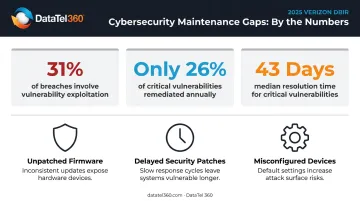
Unpatched firmware, misconfigured hardware, and outdated software create both operational and security exposure. Common maintenance gaps that open the door to breaches include:
- Firmware left unpatched across network and server hardware
- Security patches delayed beyond acceptable windows
- Misconfigured devices never audited after initial deployment
The 2025 Verizon Data Breach Investigations Report, based on 31,850 incidents and 22,345 confirmed breaches, found that vulnerability exploitation was an initial access vector in 31% of breaches. Only 26% of critical vulnerabilities in CISA's Known Exploited Vulnerabilities catalog were fully remediated during the prior year, with a median resolution time of 43 days.
Firmware updates and security patch reviews belong on every maintenance schedule, not just on the security team's radar.
A Growing Market Signal
Investment trends confirm what IT teams already know firsthand. Research and Markets projects the global data center maintenance and support services market to grow from $15.4 billion in 2024 to $28.5 billion by 2030 — driven by rising data volumes, stricter uptime demands, and the growing complexity of enterprise infrastructure.
Types of Data Center Maintenance
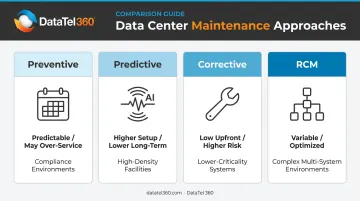
There are four primary maintenance approaches, each with different cost structures and risk profiles. Most organizations use a combination.
Preventive Maintenance
Follows a fixed schedule of inspections, part replacements, and system checks regardless of current equipment condition. Effective for baseline protection and compliance requirements. The trade-off: you may service components that don't need it yet, which adds cost without added value.
Predictive Maintenance
Rather than working from a calendar, predictive maintenance uses sensor data and AI/ML analysis to spot failure patterns early — so technicians intervene when the equipment actually needs it, not when the schedule says so. Schneider Electric's analysis of 6,000 connected UPS systems reported 66% fewer break-fix interventions and a 70% reduction in electrical failure risk compared to traditional service plans. Compass Datacenters achieved 20% OpEx savings over two years after moving 78 modular data centers to condition-based maintenance.
Corrective Maintenance
Addresses identified problems before they impact end users. Distinct from emergency repair — it resolves known issues proactively once detected. Lower upfront cost, but carries higher risk if issues are caught too late to prevent service degradation.
Reliability-Centered Maintenance (RCM)
A strategic hybrid that prioritizes maintenance resources toward the most mission-critical systems first. It works best for organizations managing complex, multi-system environments — think large data halls or multi-site deployments — where protecting Tier 1 infrastructure matters far more than servicing every peripheral on the same schedule.
Quick Comparison
| Approach | Cost Profile | Best Fit |
|---|---|---|
| Preventive | Predictable, may over-service | Compliance-driven environments |
| Predictive | Higher setup cost, lower long-term spend | High-density or always-on facilities |
| Corrective | Low upfront, higher reactive risk | Lower-criticality systems |
| RCM | Variable, optimized by priority | Complex, multi-system environments |
Core Services in a Data Center Maintenance and Support Program
Hardware Inspection and Repair
Routine physical assessment of servers, switches, routers, storage arrays, and cabling — including identifying worn components, loose connections, and hardware approaching end-of-service-life (EOSL). Catching degraded components on a schedule is far less disruptive than discovering them during an outage.
Environmental Monitoring
Continuously tracking temperature, humidity, and airflow across the facility. ASHRAE recommends inlet temperatures of 18–27°C (64.4–80.6°F) for air-cooled environments, with humidity controlled to specific dew point ranges. Alert thresholds should be configured to notify staff before conditions reach equipment risk levels.
Power Systems Maintenance
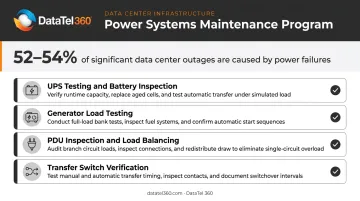
Power is the leading cause of significant data center outages — accounting for 52% in Uptime's 2023 survey data and 54% in 2024. A complete power maintenance program covers:
- UPS testing and battery inspection
- Generator load testing under realistic conditions
- PDU inspection and load balancing
- Transfer switch verification
Visual inspection alone is not sufficient — systems must be tested under load to confirm they'll perform when needed.
Network Infrastructure and Structured Cabling Support
Once power integrity is confirmed, physical network connections are the next reliability variable. Fiber optic cabling, patch panels, and cable management are frequently overlooked — and frequently the source of connectivity and performance problems. Cabling maintenance includes:
- OTDR testing to identify signal degradation in fiber runs
- Verifying Cat6/Cat6A termination integrity
- Patch panel audits and labeling reviews
- Cable management organization in MDF/IDF environments
DataTel 360's infrastructure work includes Fluke-certified copper testing and OTDR-tested fiber on every engagement, with labeled panels and as-built documentation delivered as standard. Any technician can work from accurate records rather than undocumented infrastructure.
Security and Firmware Updates
Software-side maintenance is equally essential. Firmware patches, security updates, and access control reviews should be part of every maintenance cycle — not deferred until a vulnerability forces the issue. A complete security maintenance checklist typically covers:
- Applying vendor-released firmware patches on a defined schedule
- Reviewing BIOS, NIC, and storage controller firmware versions
- Auditing remote access credentials and management interface permissions
- Verifying that out-of-band management ports are not exposed to public networks
Data Center Maintenance Best Practices
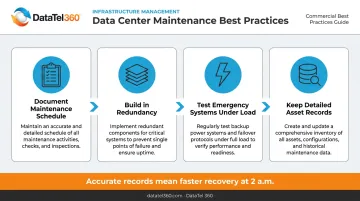
Effective maintenance comes down to four disciplines executed consistently:
- Document a maintenance schedule with defined task owners, frequencies, and completion records. Ad-hoc maintenance is not a program — it's a gap waiting to surface during an incident.
- Build in redundancy across power supplies, cooling units, and network connections. Uptime Institute's Tier 3 standard (concurrently maintainable) means maintenance can run on one component without taking the system offline.
- Test emergency systems under load — not just visual inspections. Backup generators, UPS units, and fire suppression systems must be exercised on a defined schedule. Equipment that hasn't been tested hasn't been maintained.
- Keep detailed asset records covering hardware age, warranty status, firmware versions, and maintenance history. This lets teams anticipate lifecycle issues, plan replacements proactively, and cut troubleshooting time when something fails.
When infrastructure is labeled, tested, and recorded accurately, the technician responding to a 2 a.m. outage isn't starting from scratch — and that distinction often determines how fast the facility comes back online.
How to Choose a Data Center Maintenance and Support Partner
Key Evaluation Criteria
When assessing external maintenance providers, focus on:
- Field-experienced engineers — certifications matter, but real-world troubleshooting experience in live data center environments matters more
- Multi-vendor hardware support — your environment likely spans multiple manufacturers; a partner locked to one platform creates gaps
- Guaranteed response times — confirm what "24/7 support" actually means in practice: is dispatch live, or does an on-call technician need to be paged?
- Geographic coverage — for multi-site organizations, a partner with consistent national reach matters as much as local responsiveness
The Case for a Single-Source Partner
Managing separate vendors for cabling, networking, hardware, and emergency support creates coordination problems — and when something fails, accountability disappears into the gap between vendors. A single-source partner holds responsibility across the full infrastructure stack.
DataTel 360 is built around this model. Founded in 1998 and serving businesses across Atlanta, the Southeast, and nationwide through TechDispatch360, they cover structured cabling, fiber optic infrastructure, MDF/IDF buildouts, smart hands and remote hands services, rack and stack, and 24/7/365 live dispatch support under one engagement.
Every project includes Fluke-certified copper testing, OTDR-tested fiber, labeled panels, and as-built documentation — so the infrastructure record is accurate whether it's routine maintenance or an emergency call at 2 a.m.
For multi-site organizations, TechDispatch360 extends that same accountability nationwide, with same-day or next-day on-site support available in their primary service areas.
In-House vs. Outsourcing
The right answer depends on three factors:
- Internal expertise — do you have engineers with hands-on data center experience, or is infrastructure support a secondary responsibility for your IT team?
- Staffing capacity — can your team realistically cover after-hours emergencies, scheduled maintenance, and documentation requirements simultaneously?
- Infrastructure complexity — multi-vendor environments, fiber backbone, and aging hardware amplify the skill requirements
For most businesses without dedicated data center engineers on staff, outsourcing makes the most sense when any two of those three factors are a genuine gap. Trying to cover after-hours emergencies and multi-vendor troubleshooting with a generalist IT team typically costs more — in downtime and labor — than a structured support agreement would.
Frequently Asked Questions
What kind of maintenance do data centers need?
Data centers require a combination of preventive, predictive, corrective, and reliability-centered maintenance. Most organizations benefit from a tailored mix based on infrastructure criticality, budget, and risk tolerance.
How often should data center maintenance be performed?
Frequency varies by system type and OEM guidance. Most OEM service plans recommend annual UPS preventive maintenance, with quarterly or semi-annual options available. Environmental and power monitoring should be continuous, with comprehensive physical inspections performed at least annually.
What is the difference between preventive and predictive maintenance?
Preventive maintenance runs on a fixed calendar schedule regardless of equipment condition. Predictive maintenance uses real-time sensor data and monitoring to trigger service only when conditions indicate an impending issue — reducing over-servicing while catching problems earlier.
What are the warning signs that data center infrastructure needs immediate attention?
Common indicators include unexpected system slowdowns, increased error logs, temperature fluctuations, unusual hardware sounds, and recurring connectivity issues. Any of these signals warrants prompt inspection, as reactive repairs after a full failure are significantly more costly than addressing early warning signs.
Should businesses manage data center maintenance in-house or outsource it?
It depends on internal expertise, staffing capacity, and infrastructure complexity. Businesses without dedicated data center engineers typically get better coverage, faster response times, and lower total cost by outsourcing to a certified provider.
How much does data center maintenance and support typically cost?
Costs vary based on infrastructure size, equipment types, number of locations, and required service levels. Smaller single-site environments may spend a few thousand dollars annually, while multi-location or mission-critical facilities often require more comprehensive contracts. Getting an itemized quote from a qualified provider is the clearest path to accurate budgeting.