For Atlanta-area businesses and organizations across the Southeast, the difference between a smooth cutover and a chaotic first week usually comes down to four decisions made weeks before moving day. This post covers each one.
Key Takeaways
- Contact your telecom carrier immediately after confirming your move date — some circuit types require 60–90 days of lead time
- Review existing service contracts for termination fees and notice periods before making any changes
- A professional site survey at the new location surfaces cabling gaps and carrier availability issues early
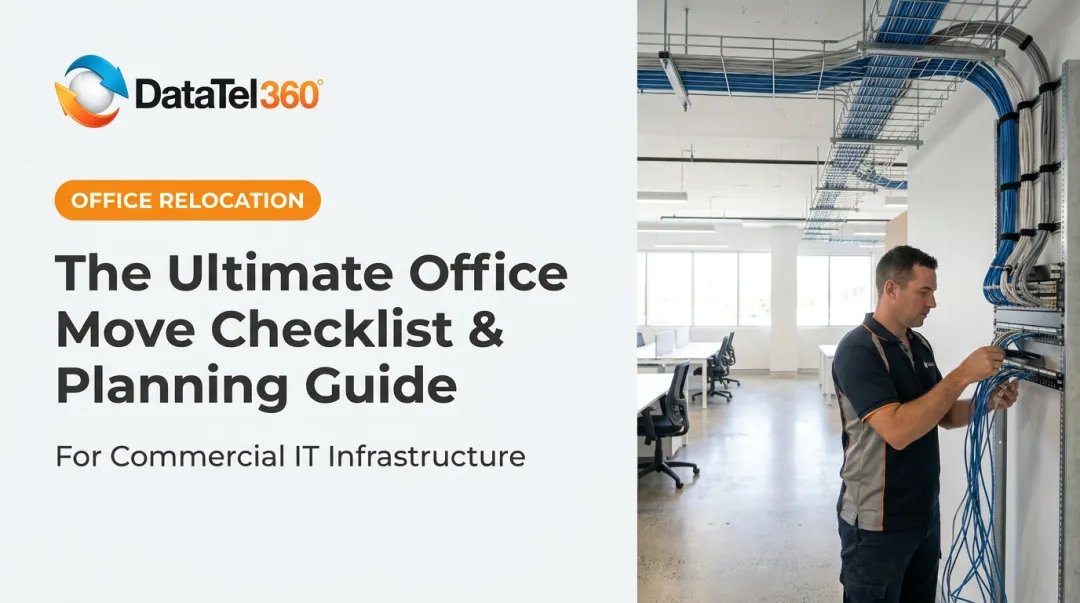
- Follow the correct installation sequence: cabling first, carrier circuits second, phone system last
- Office relocation is one of the best opportunities to move from a legacy PBX to a cloud-based phone system
Tip 1: Notify Your Telecom Carrier as Early as Possible
The single most common mistake businesses make is treating carrier notification as a moving-week task. It isn't.
Most standard business internet services can be transferred with reasonable lead time. Comcast Business, for example, may schedule a pre-installation visit as little as 24–72 hours before the final installation date. But that assumes the service is available at your new address and the infrastructure is already in place. When it isn't, timelines stretch considerably.
Fiber Availability Is Address-Specific
AT&T advertises dedicated internet installations in as little as 10 days, but that applies only at approximately 3 million fiber-ready business locations. If your new building requires a new fiber build or extension, you're looking at a much longer process. No carrier publishes a universal average for construction-dependent installs.
This is why the FCC's National Broadband Map is a useful starting point — it shows provider availability, technology types, and advertised speeds at individual business addresses, not just by ZIP code. Check the specific address early, before you've committed to a lease or set a move date.
Confirm Your Phone Numbers Can Move With You
Number portability is protected under FCC rules when you remain in the same geographic area. Simple one-line ports must generally be completed within one business day. Multi-line business ports are more complex and take longer.
Key facts to confirm with your carrier before the move:
- Whether your existing numbers are eligible to transfer to the new address
- Whether VoIP numbers remain tied to the account (rather than the physical location)
- What forwarding or diversion options are available during any porting window
The old service should never be disconnected before a port is initiated. Get this confirmed in writing.
Tip 2: Review Your Existing Telecom Contracts and Audit Your Services
Before canceling, transferring, or replacing any service, pull your contracts and read them carefully. Termination fees are real and can be significant.
AT&T, for example, calculates its early termination fee for covered business internet services at $25 multiplied by the number of months remaining in the term. Comcast Business governs relocation, termination, and applicable charges through the signed service order and customer terms — not through a standard policy posted online. These figures vary by product and contract, which means there's no shortcut here.
What to Look for in Each Contract
- Service end date and remaining term
- Required notice period before termination or transfer (some providers require 60–90 days)
- Whether the service can transfer to a new physical address at all
- Applicable termination or relocation fees
Use the Move as an Audit Opportunity
A relocation is one of the few moments when every service gets touched simultaneously. That makes it a natural window to ask: does each line, circuit, or plan still reflect how the business actually operates?
A service audit often surfaces:
- Phone lines assigned to employees who left years ago
- Redundant internet circuits ordered during a past expansion that were never removed
- Service tiers sized for a headcount that no longer exists
Eliminating these before signing the new lease directly reduces monthly costs at the new location — without cutting anything the business actually uses. That kind of review is harder to do objectively from the inside — internal teams often lack visibility into the full contract landscape or are too close to day-to-day operations to catch what's redundant. DataTel 360's carrier-neutral sourcing means the audit focuses on what actually fits the environment, not what a single vendor is pushing.
Tip 3: Schedule a Professional Site Survey and Cabling Assessment
Walking through a new office space and assuming the existing infrastructure will work is one of the most expensive assumptions a business can make. The wiring in the walls may look fine — and still be completely inadequate.
What a Cabling Assessment Actually Covers
Inherited cabling varies widely in quality. Understanding what you have — and what you need — requires a structured evaluation:
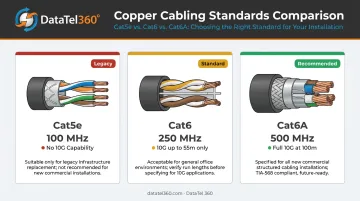
| Cabling Type | Bandwidth | 10G Capability |
|---|---|---|
| Cat5e | 100 MHz | No |
| Cat6 | 250 MHz | Limited (up to ~55m) |
| Cat6A | 500 MHz | Full 100m runs |
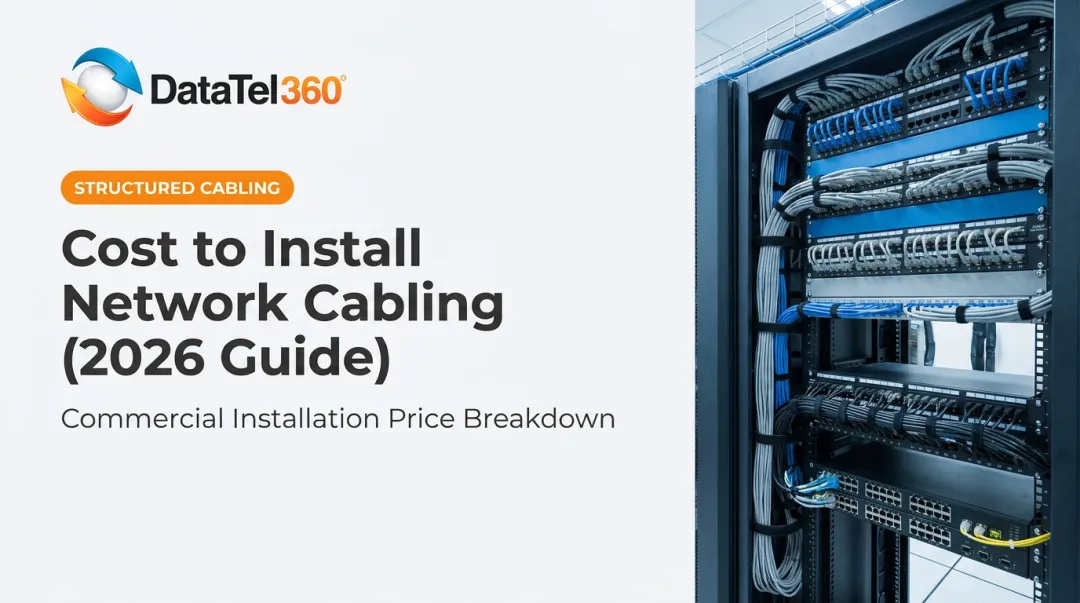
According to BICSI's 2022 standards presentation, Cat6A is the correct copper option for full-distance 10GBASE-T runs. If the inherited cabling is Cat5e or older Cat6 with insufficient port counts, that needs to be known before move day — not discovered the morning staff arrive.
Carrier Availability at the Building Level
Not every building has multiple ISP options. Some have no pre-existing fiber infrastructure at all, which directly affects what internet service can be ordered, how long it will take to provision, and what it will cost. This must be verified at the building address level, not assumed based on the surrounding neighborhood.
Vertical Systems Group's 2025 data shows that more than 80% of medium and large commercial buildings in the U.S. are fiber-lit, but fiber presence at the curb doesn't guarantee the building has active, terminated fiber onsite. That distinction matters when ordering service.
Server Room and Wireless Coverage
Two areas businesses routinely underestimate:
- IT closet/server room capacity: Rack space, electrical load, and cooling adequacy all need evaluation before equipment moves. UPS systems and structured cable management should be confirmed as part of the coordinated setup at the new location.
- Wireless coverage for the actual floor plan: New spaces almost never match old ones. Open ceilings, concrete walls, and reconfigured rooms create coverage gaps that predictive wireless surveys catch before installation — not after staff start complaining.
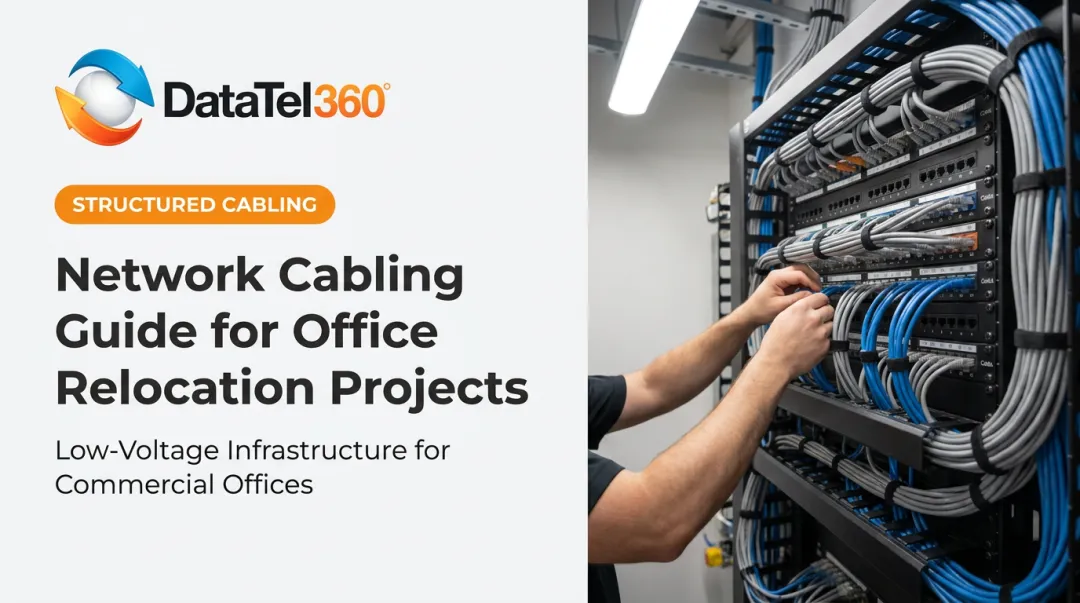
DataTel 360 provides professional site surveys for businesses throughout Atlanta, Georgia, and the broader Southeast — including Fluke-certified copper testing, OTDR-tested fiber (optical continuity and loss verified), and as-built drawings delivered at project close.
Tip 4: Follow the Correct Telecom Installation Sequence
Telecom installation follows a dependency chain — each layer has to be fully in place before the next one connects. Skip a step or reverse the order, and you'll spend move-in day troubleshooting instead of working.
The Right Order of Operations
- Structured cabling and data drops — All Cat6/Cat6A runs, patch panels, and fiber backbone must be installed, tested, and certified before anything else connects
- Internet and carrier circuit activation — The ISP circuit terminates into a working network infrastructure; without cabling in place, there's nothing for it to connect to
- VoIP or phone system installation — The phone system requires both active internet and a completed network to register and communicate
- Workstations and peripherals — End-user connections come last, once every upstream layer is confirmed operational
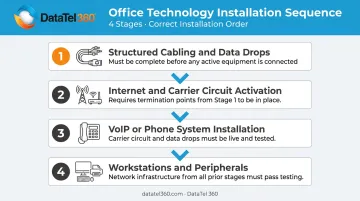
The goal is simple: internet and phones should be live and tested before staff arrive at the new location. Moving into an office with no connectivity on day one is avoidable — it happens almost entirely because the installation sequence was compressed or reversed.
Scheduling Strategy
Once the sequence is mapped, the next decision is timing. If the phone system is hardware-based, scheduling the physical move during a low-traffic period — a long holiday weekend, for example — reduces labor costs and minimizes disruption to client-facing operations. Service is unavailable from the moment equipment is disconnected until it's reconnected and integrated at the new location, which makes cutover timing a real operational decision.
The Upgrade Window
That cutover timing question also raises a larger one: if the hardware has to move anyway, is it worth moving it at all? Office relocation removes the hardware dependency that keeps businesses on aging PBX systems. When equipment is already being disconnected and transported, migrating to a cloud-based phone system carries far less friction than it would mid-lease:
- Eliminates the risk of physically transporting sensitive, irreplaceable hardware
- Numbers and configurations are tied to the account, not the physical address
- Supports remote and hybrid work without additional infrastructure
- No rack space or on-site equipment to manage at the new location
According to Metrigy's 2025 research, 50.4% of businesses now use UCaaS as their only phone system, with an additional 39.2% running UCaaS alongside other platforms — a clear signal that cloud-first communications is no longer the exception.
DataTel 360 specializes in VoIP migrations and cloud phone system deployments during office relocations, with certified configurations on Zultys and Intermedia platforms. Their process includes after-hours cutovers and migration support designed to keep operations running through the transition.
Common Telecom Mistakes to Avoid During an Office Relocation
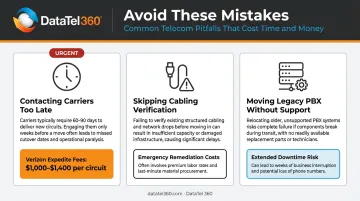
Even well-organized moves run into trouble when a few specific errors are made. These three come up most often — and all of them are preventable.
Contacting carriers too late. Waiting until two to four weeks out causes service gaps on move day, expedite charges, and potential contract violations. Verizon charges $1,000 per NaaS circuit and $1,400 for US Local Access circuits to expedite. Lumen charges $250 per request — and explicitly states that some services cannot be expedited at all.
Assuming inherited cabling is usable without verification. Uncertified or underpowered cabling discovered after staff move in requires emergency remediation at full premium rates. A pre-move survey costs a fraction of that.
Moving a legacy phone system without certified support. PBX systems require careful de-installation, transport, and reinstallation to avoid configuration loss or hardware damage. An in-house move to save money frequently results in extended downtime — the exact outcome the relocation was supposed to prevent.
Frequently Asked Questions
How far in advance should I notify my telecom carrier before an office move?
Contact your carrier as soon as the move date is confirmed. Standard business internet transfers may be arranged relatively quickly, but dedicated circuits, new fiber builds, or service in buildings without existing infrastructure can take significantly longer — sometimes many weeks. Waiting until two to four weeks out creates real risk.
Can I keep my existing business phone number when I relocate my office?
In most cases, yes — particularly with VoIP services, where numbers are tied to the account rather than a physical address. The FCC requires simple ports to complete within one business day, though multi-line business ports take longer. A telecom provider can manage the porting process and confirm eligibility at the new address.
What is the correct order of telecom installation during an office move?
Structured cabling first, internet and carrier circuits second, phone system third, workstations last. Each layer depends on the previous one being operational. Installing the phone system before the network is active, or activating internet before cabling is complete, creates delays that stack up fast.
Is an office relocation a good time to switch to a VoIP or cloud phone system?
It's one of the best times. The move already disrupts your existing setup, so switching costs less friction than it would mid-lease. A cloud phone system eliminates the need to transport PBX hardware, adds flexibility for remote and hybrid work, and ties numbers to accounts rather than physical addresses.
What happens if I skip a site survey before relocating my office?
Skipping the survey typically means discovering cabling shortfalls, inadequate power, or limited carrier options only after the move is already underway. Emergency remediation during or after a move costs significantly more than a pre-move assessment, and the resulting downtime compounds the cost further.
How long does it typically take to install new internet service at a new office location?
It depends on what's available at the building. AT&T's dedicated internet is available in as little as 10 days at fiber-ready locations — but that qualifier matters. Buildings requiring new fiber construction or carrier extensions can take substantially longer, so order service the moment the new address is confirmed.