What makes fiber failures particularly costly is how quietly they develop. Connector contamination, physical stress, and moisture infiltration rarely trigger an alarm until performance has already degraded — by which point the damage is done.
This guide covers why fiber maintenance matters, the four main maintenance approaches, warning signs your network needs attention, and a practical inspection schedule for different environments.
Key Takeaways
- Connector contamination, physical stress, and moisture intrusion are the most common fiber failure points — all preventable with routine maintenance
- Emergency repairs and full cable replacement cost far more than routine preventive maintenance
- Most commercial environments need at minimum an annual fiber inspection; outdoor and high-traffic runs need more frequent checks
- Link flapping, elevated error rates, and intermittent slowdowns often point to optical degradation, not software issues
- Accurate fault location requires specialized tools like OTDRs and fusion splicers — not standard IT kit
Why Fiber Optic Cable Maintenance Matters for Business Continuity
Fiber networks are built to be reliable, but that reputation can create a false sense of security. Because fiber rarely fails abruptly, degradation tends to go unnoticed until it has already affected operations.
The Hidden Cost of Gradual Degradation
Dirty connectors, micro-bends, and splice loss don't announce themselves. Instead, they surface as:
- Intermittent application slowdowns
- Dropped VoIP calls or choppy video conferencing
- Reduced throughput on bandwidth-intensive workloads
Teams frequently misattribute these symptoms to software bugs, ISP issues, or aging equipment, spending hours troubleshooting in the wrong direction while the actual problem sits in the fiber plant.
Accelerated Aging When Maintenance Is Skipped
Neglected fiber infrastructure ages faster than it should. Dirty connectors permanently damage ferrule end-faces when mated under contamination. Cables routed with sharp bends develop micro-fractures over time.
Outdoor runs exposed to moisture see protective jackets degrade, eventually allowing water infiltration into splice closures that spreads along the cable run. Each failure mode accelerates the timeline toward full cable replacement, turning what should be a decades-long asset into a five-year problem.
Compliance in Regulated Industries
For organizations operating under HIPAA, PCI DSS, or FISMA frameworks, network availability isn't just an operational concern. Each framework ties directly to fiber infrastructure controls:
- HIPAA Security Rule — requires covered entities to maintain availability and integrity of electronic protected health information, including contingency planning for system failures
- PCI DSS v4.0.1 — mandates documented incident response and business continuity controls
- NIST SP 800-34 — the federal contingency planning guide, requires recovery strategies and tested procedures for federal systems
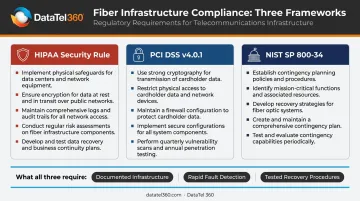
These standards don't specify a fiber uptime percentage, but they do require exactly what proactive maintenance delivers: documented infrastructure, rapid fault detection, and tested recovery procedures.
Types of Fiber Optic Cable Maintenance
Not all fiber maintenance looks the same. The right approach depends on whether cables are indoor or outside plant (OSP), how critical the links are, and how long the infrastructure has been in service.
Routine / Preventive Maintenance
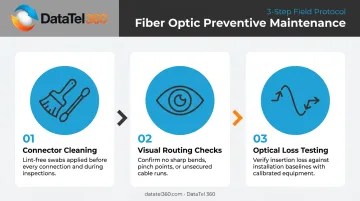
Preventive maintenance is the lowest-cost, highest-return category. It typically includes:
- Connector cleaning — lint-free swabs and appropriate cleaning solutions applied before every connection and during scheduled inspections
- Visual routing checks — confirming no sharp bends, pinch points, or unsecured cable runs have developed since the last inspection
- Optical loss testing — verifying end-to-end insertion loss against installation baselines using calibrated test equipment
Preventive maintenance is sufficient for lower-traffic indoor cable plants with stable environments and protected patch panels that see minimal human interaction. Cables secured behind locked panels rarely need more than annual attention.
Corrective / Reactive Maintenance
Reactive maintenance gets triggered by an event: a sudden signal loss, a physical cable cut from construction work, moisture discovered in a splice closure, or a connector that's been visibly damaged.
Relying exclusively on reactive maintenance creates compounding costs:
- Water infiltration caught during a failure is far harder to remediate than one found during a routine closure inspection
- Emergency service calls carry higher labor rates than scheduled visits
- Missing documentation or spare components extends diagnosis time — and the outage window with it
That said, failures still happen. DataTel 360 provides 24/7/365 emergency dispatch with same-day on-site response for fiber breaks and critical outages across Atlanta and the Southeast — including the 2 a.m. Saturday calls that can't wait until Monday.
Predictive / Condition-Based Maintenance
Predictive maintenance uses ongoing performance monitoring — optical power levels, bit error rates, and OTDR trace comparisons over time — to catch degradation trends before they reach failure thresholds.
This approach is most cost-effective for environments where even brief outages are unacceptable: data centers, hospital networks, and multi-site enterprises with constant high-bandwidth traffic.
The process starts with a baseline OTDR trace at installation, then compares subsequent traces periodically. Anomalies that appear between snapshots indicate a developing problem — one that can be addressed before it becomes an outage.
Major / Overhaul Maintenance
A full cable plant overhaul is warranted when:
- Attenuation has exceeded original design margins
- Infrastructure predates modern connector and splicing standards (typically 15–20 years or older)
- A casualty event — flooding, fire, or major construction damage — requires complete cable replacement
Overhaul events are also the right time to increase fiber count, add service loops for future restoration flexibility, and rebuild documentation from scratch. DataTel 360 delivers OTDR-certified test baselines, labeled panels, and full as-built drawings as standard deliverables on every project — including post-overhaul rebuilds — so clients leave with documentation that can anchor future maintenance decisions.
Warning Signs Your Fiber Optic Network Needs Maintenance or Repair
Unlike copper cabling failures, fiber faults are often invisible at the physical layer. By the time a link goes completely dark, significant degradation has usually already occurred. Knowing what to watch for at the network level lets IT and facilities teams catch problems earlier.
Performance and Application Degradation
Gradual signal attenuation from dirty connectors or stressed cable routing typically surfaces first as:
- Intermittent slowdowns on specific applications
- Dropped or degraded VoIP calls
- Video conferencing quality issues that appear without any network configuration changes
If bandwidth-intensive applications are underperforming without any changes to routing, switching, or ISP service, a fiber plant inspection should be the first diagnostic step — not the last.
Unusual Network Behavior and Error Rates
Several measurable network-layer indicators point to optical power loss rather than software or configuration problems:
- Elevated bit error rates (BER) on links that were previously clean
- Link flapping — repeated up/down events occurring when received signal crosses an optic's operational threshold
- Unexpected packet loss on previously stable links
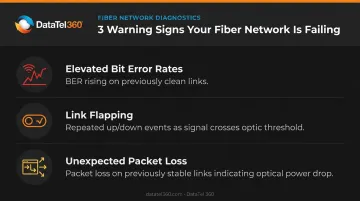
When received optical power drops below a module's low-warn threshold, the cause is almost always a far-end transceiver issue or a problem in the fiber path itself — not the switch. Since threshold values vary by module, cross-reference the optic's datasheet against the switch's optical monitoring output to confirm.
Not every fault shows up in network monitoring. Some warning signs are visible on the cable plant itself.
Visible Physical Damage or Environmental Changes
Observable signs that warrant immediate inspection:
- Kinking, crushing, or sharp bending of visible cable sections
- Cracked or dirty connector ferrules visible under an inspection loupe
- Damaged outer jackets on outdoor or aerial cables
- Evidence of moisture, corrosion, or pest activity near underground splice closures
Recurring Issues and Failed Temporary Fixes
If the same link keeps going down and patchcord swaps or equipment resets only hold briefly, the problem is almost certainly in the fiber cable plant itself. Proper fault location with an OTDR, which generates a distance-based trace of every loss event along the link, is the only way to identify and permanently resolve the issue.
Fiber Optic Cable Maintenance Schedule: General Guidelines
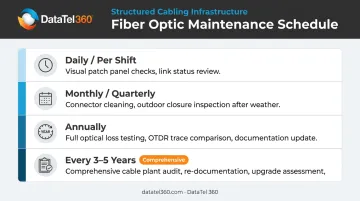
Maintenance frequency depends on environment, traffic volume, and installation age. As the Fiber Optic Association's FAQ notes, no industry standard mandates specific periodic testing intervals — these decisions require judgment based on each site's conditions. Use the framework below as a practical starting point.
| Frequency | Scope |
|---|---|
| Daily / Per Shift | Visual check of high-traffic patch panels and patchcords; review link status lights on active equipment for unexpected alarms |
| Monthly / Quarterly | Inspect and clean connectors on frequently accessed panels; check aerial runs and outdoor splice closures after weather events for jacket damage or moisture |
| Annually | Full optical loss testing across all links compared against installation baselines; OTDR trace comparison for outdoor and long-haul runs; update documentation for any moves, adds, or changes |
| Every 3–5 Years (or after a major event) | Comprehensive cable plant audit — splice closure inspection, service loop verification, spare fiber inventory, full re-documentation, and infrastructure upgrade assessment |
This table covers typical intervals. The right cadence for your installation may shift based on the conditions below.
Adjusting for Environment and Traffic Volume
Inspect more frequently when you have:
- Campus backbones and data center interconnects under constant high-bandwidth load
- Hospital networks where link availability affects clinical operations
- Outdoor and aerial runs in environments with weather extremes, construction activity, or rodent or pest activity
- Any infrastructure that hasn't been formally documented or baseline-tested
Annual cycles are typically sufficient for:
- Low-traffic branch office installations with sealed, locked patch panels
- Indoor premises cabling installed recently and documented to TIA-568.3-E standards
- Links with stable, consistent performance history and no recent physical changes nearby
Any major renovation, nearby construction project, or recurring link issue should trigger an unscheduled inspection.
Conclusion
Fiber optic infrastructure is a long-term business asset. Like any asset, its reliability and lifespan depend on the quality of maintenance it receives, not just the quality of the original installation.
The financial case is straightforward: scheduled maintenance costs predictable amounts at planned intervals, while reactive repair after an outage costs more in labor, parts, emergency rates, and lost productivity.
The 2024 Uptime Institute data showing that 80% of serious outages could have been prevented through better operational practices makes a strong argument for building a proactive maintenance program before a failure forces the issue.
For businesses in Atlanta and across the Southeast, DataTel 360 brings over 25 years of commercial fiber optic experience, certified field engineers, OTDR-documented testing on every project, and 24/7 emergency dispatch for unplanned failures. Contact DataTel 360 at 770-441-9999 or visit datatel360.com to discuss a maintenance plan for your fiber infrastructure.
Frequently Asked Questions
How much does it cost to repair fiber optic cable?
Repair costs vary significantly based on fault type, location accessibility, and scope. Connector cleaning is the least expensive scenario; fusion splicing a buried cable break involves higher labor, access, and testing costs. Emergency dispatch rates are higher than scheduled work. For accurate pricing, contact a fiber contractor with a description of the fault and site conditions.
How long does fiber optic cable repair typically take?
A patchcord swap or simple connector replacement can be completed in under an hour. Locating and splicing a buried cable break — depending on site access, fault location accuracy, and crew availability — may take several hours to a full day. Emergency night or weekend calls add mobilization time.
Can a fiber optic cable be repaired without full replacement?
Yes, in most cases. Fusion splicing allows technicians to rejoin broken fibers with minimal signal loss, and a damaged section can be spliced out and replaced with a short cable segment. Full replacement is typically only necessary when damage is extensive or the cable run is no longer serviceable.
How often should a business have its fiber optic cables inspected?
Most commercial environments should schedule a formal fiber inspection at least annually. High-traffic backbones, outdoor runs, and healthcare or data center environments warrant quarterly checks. Nearby construction, major renovations, or recurring link issues should trigger an immediate inspection regardless of schedule.
What is the difference between fusion splicing and mechanical splicing in fiber repair?
Fusion splicing uses heat to permanently weld two fiber ends together, producing very low signal loss and long-term reliability — the preferred method for permanent or outdoor repairs. Mechanical splicing uses an alignment sleeve and index-matching gel for a faster, slightly higher-loss connection, used as a temporary fix when fusion equipment isn't on site.
Should businesses manage fiber optic maintenance in-house or hire a professional?
Basic visual inspections can be handled internally, but accurate fault location and repair require specialized equipment — OTDR, fusion splicer, calibrated loss test gear — and technicians trained to interpret results correctly. For most businesses, professional service is more reliable and cost-effective than investing in equipment and training for infrequent use.