The Wi-Fi as a Service market was valued at $9.27 billion in 2025 and is forecast to reach $21.96 billion by 2030 — an 18.8% CAGR that reflects how many organizations are moving away from self-managed wireless and toward professionally delivered solutions. The demand makes sense: a consumer-grade router can broadcast a signal. A managed WiFi service designs, secures, monitors, and maintains the network as an ongoing business function.
This guide covers what managed business WiFi actually is, how to evaluate providers, and which ones deserve serious consideration in 2026.
Key Takeaways
- Managed WiFi covers the full lifecycle — design, deployment, monitoring, security, and support — not just the hardware
- The best providers offer vendor-neutral hardware selection, proactive monitoring, and written SLAs
- Enterprise IoT growth is accelerating network complexity, making professional management more critical
- Evaluate providers on SLA specifics, multi-location capability, and security architecture over brand recognition
- DataTel 360, Cisco Meraki, Aruba (HPE), Extreme Networks, and Cradlepoint are the top options worth evaluating in 2026
What Is Managed Business WiFi — and Why Does It Matter in 2026?
Managed business WiFi is a service model where a provider designs, deploys, and actively monitors enterprise-grade wireless infrastructure on your behalf. Self-managed WiFi shifts that burden to your IT staff or business owner, who typically respond reactively when something breaks rather than stopping problems before users notice them.
Why 2026 Raises the Stakes
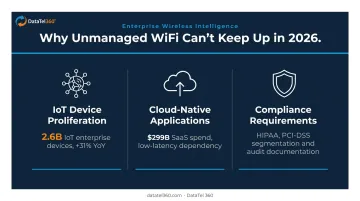
Three forces are pushing wireless demands beyond what any unmanaged setup can handle reliably:
- IoT device proliferation: Gartner forecasts 2.6 billion IoT-enabled enterprise machine customers in 2025, up 31% year-over-year — each device competing for spectrum and requiring access control
- Cloud-native applications: SaaS spending hit $299 billion in 2025, meaning more critical workloads depend on consistent, low-latency wireless connectivity across every industry
- Compliance requirements: Healthcare and retail organizations face HIPAA and PCI-DSS obligations that demand proper access controls, network segmentation, and audit-ready documentation — none of which a basic router provides out of the box
WiFi 6 and WiFi 6E access points support theoretical speeds up to 9.6 Gbit/s. That capacity means nothing if the network is poorly planned or left unmonitored — coverage gaps, interference, and security exposure are all design and management problems, not hardware ones.
The providers below are evaluated on network design capability, cloud management tools, security features, SLA quality, scalability, and industry fit.
Best Managed Business WiFi Service Providers in 2026
Providers on this list were selected based on their ability to deliver end-to-end managed WiFi — not just hardware resale. The criteria: proven network design expertise, active monitoring and alerting, strong SLA commitments, multi-location capability, and demonstrated results across business verticals including healthcare, retail, hospitality, and enterprise.
DataTel 360
Atlanta-headquartered and operating since 1998, DataTel 360 is a single-source technology infrastructure partner offering managed wireless networking as part of a comprehensive stack that also includes structured cabling, fiber, and cloud VoIP. That integration matters: when your cabling, MDF/IDF buildout, and wireless network all come from one accountable contractor, there's no finger-pointing when something goes wrong.
DataTel 360's defining characteristic is its vendor-neutral approach. Rather than pushing one hardware brand for margin reasons, their certified senior engineers assess each client's physical environment — accounting for concrete walls, metal racking, elevator shafts, and high-ceiling warehouses — and recommend the access points and management platform that fit the space.
Deployments are preceded by both predictive and on-site wireless surveys, with coverage tuned to eliminate dead zones before installation begins.
Their multi-industry experience spans healthcare, legal, manufacturing, logistics, retail, hospitality, and multi-location enterprises. For organizations that need compliance-aware network design — VLAN segmentation for guest, corporate, and IoT traffic; access controls for HIPAA or PCI-DSS environments — DataTel 360 treats segmentation as a design standard rather than an add-on. Nationwide coverage is supported through TechDispatch360 field services.
| Category | Details |
|---|---|
| Deployment Model | On-site design and installation by certified engineers, followed by ongoing remote monitoring and proactive management |
| Key Features | Vendor-neutral hardware selection, network segmentation (guest/corporate/IoT VLANs), 24/7/365 live support, full network visibility reporting, structured cabling integration |
| Best For | Businesses in Atlanta and the Southeast needing a trusted single-source partner; multi-location enterprises and regulated industries (healthcare, legal, financial) |
Cisco Meraki
Cisco Meraki is the dominant cloud-managed networking platform for enterprise WiFi. Its centralized dashboard gives IT teams and MSPs full visibility and control over access points, switches, and security appliances across any number of locations from a single interface — which is why it's the reference standard for multi-site deployments.
Key platform capabilities include:
- AI-RRM automatically adjusts channel and power settings across access points to maintain consistent RF performance
- Scheduled firmware updates managed through the dashboard eliminate the manual patching burden common in self-managed networks
- Meraki MX security appliance adds content filtering and intrusion detection within the same unified interface
Cisco was recognized as a Leader in the IDC MarketScape: Worldwide Enterprise Wireless LAN 2025 Vendor Assessment. Most deployments are delivered through certified Meraki MSP partners who provide the managed service layer on top of the hardware.
| Category | Details |
|---|---|
| Deployment Model | Hardware purchased or licensed through Cisco/channel partners; managed services delivered by certified Meraki MSPs |
| Key Features | Cloud dashboard, AI-RRM RF optimization, scheduled firmware updates, integrated MX security, scalable from SMB to enterprise, location analytics |
| Best For | Mid-market to enterprise businesses with multi-site deployments and in-house or outsourced IT needing centralized network visibility |
Aruba (HPE)
Aruba, an HPE company, delivers enterprise-grade wireless LAN solutions powered by AIOps through its Aruba Central cloud platform. The platform provides Client Experience Scores and anomaly detection that flag performance issues before they generate helpdesk tickets — a meaningful advantage in high-density environments where manual monitoring can't keep pace.
Aruba's ClearPass Policy Manager enforces Zero Trust security principles: role-based access control, device-based policies, and least-privilege network access across wired and wireless infrastructure. In practice, a guest device, a corporate laptop, and a medical IoT sensor can all connect to the same physical network while remaining completely isolated from each other at the policy level.
HPE reported that Gartner positioned Aruba as a Leader for the 18th consecutive time in the 2024 Magic Quadrant for Enterprise Wired and Wireless LAN Infrastructure. Hospital de Amor deployed Aruba WiFi 6 infrastructure to support up to 2,500 simultaneous patient devices at 300–400 Mbps — a real-world benchmark for high-density healthcare performance.
| Category | Details |
|---|---|
| Deployment Model | Hardware-as-a-service or CapEx purchase; managed through Aruba Central by HPE/Aruba-certified MSPs |
| Key Features | AIOps anomaly detection, Client Experience Scores, Zero Trust via ClearPass, high-density AP portfolio, role-based access control |
| Best For | Healthcare, higher education, large retail, and industrial environments requiring high-density coverage, compliance-grade security, and AI-driven optimization |
Extreme Networks
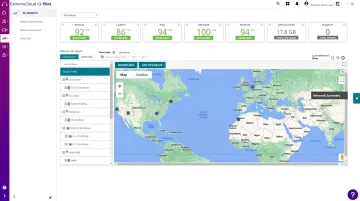
Extreme Networks provides cloud-managed wireless infrastructure through its ExtremeCloud IQ platform, with subscription-based licensing that gives businesses flexibility in how they consume and scale the service. The platform centralizes policy management, SSID configuration, VLAN assignment, and performance analytics — reducing the manual IT overhead that builds up over time in self-managed environments.
Extreme was also recognized as a Leader in the IDC MarketScape: Worldwide Enterprise Wireless LAN 2025 Vendor Assessment. Their vertical-specific deployments include Crowne Plaza Petra (hospitality), Allegheny College (higher education), and West Suffolk NHS Foundation Trust (a 430-bed hospital serving 275,000 people). That track record across distinct environments — each with different density, compliance, and guest network requirements — reflects platform maturity rather than one-size-fits-all implementation.
| Category | Details |
|---|---|
| Deployment Model | Subscription-based cloud management (ExtremeCloud IQ) delivered through Extreme-certified MSPs; flexible hardware deployment options |
| Key Features | ExtremeCloud IQ dashboard, policy automation, guest network management, multi-SSID and VLAN support, analytics and reporting suite |
| Best For | Hospitality, education, and healthcare organizations seeking subscription-based managed WiFi with strong automation and reporting |
Cradlepoint (Ericsson)
Cradlepoint, now part of Ericsson, occupies a distinct position on this list: it's primarily a Wireless WAN provider rather than a traditional indoor enterprise WLAN vendor. Where Meraki, Aruba, and Extreme focus on WiFi access points inside buildings, Cradlepoint's NetCloud platform manages cellular-connected routers and adapters for businesses that need branch connectivity, failover coverage, or rapid deployment where fixed fiber isn't an option.
That distinction matters for how you evaluate it.
For distributed retail chains, logistics operators, field crews, and pop-up sites, Cradlepoint's LTE/5G WAN management — with zero-touch provisioning and built-in SD-WAN — fills a gap the other platforms don't address. It won't replace indoor WLAN management for a dense office or hospital floor, but for mobile or fiber-constrained locations, it's purpose-built for exactly that scenario.
| Category | Details |
|---|---|
| Deployment Model | Cloud-managed cellular/wireless edge hardware; zero-touch provisioning via NetCloud; managed through MSP partners |
| Key Features | NetCloud SD-WAN platform, LTE/5G primary and failover connectivity, zero-touch provisioning, centralized management for distributed locations |
| Best For | Retail chains, logistics, field operations, and businesses needing rapid deployment or cellular-backed connectivity where fixed fiber isn't viable |
How We Chose the Best Managed Business WiFi Providers
The most common mistake businesses make when evaluating WiFi providers is focusing on hardware brand rather than the management, support, and expertise wrapped around it. A Cisco Meraki access point installed by an inexperienced contractor with no monitoring in place performs worse than a less-recognized brand installed correctly by engineers who watch the network daily.
The Evaluation Criteria
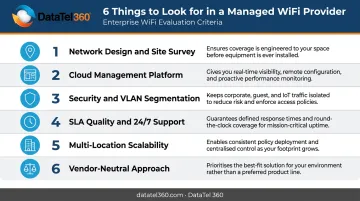
Providers were assessed on six factors — each tied to a concrete business outcome:
- Network design and site survey capability → Proper AP placement eliminates dead zones before they become support tickets
- Cloud management platform maturity → Centralized dashboards enable proactive troubleshooting instead of reactive firefighting
- Security features including VLAN segmentation → Guest/corporate/IoT isolation reduces the blast radius of any security incident and helps satisfy PCI-DSS scoping requirements
- SLA quality and 24/7 support availability → Defined response times create accountability; without them, "we'll look into it" is the only commitment you have
- Multi-location and multi-industry scalability → A provider that can handle 3 locations today needs to handle 30 tomorrow without rebuilding the architecture
- Vendor-neutral vs. single-brand approach — Vendor-neutral providers recommend what fits the environment. Single-brand providers recommend what they sell.
A Note on Pricing
No standard pricing benchmark exists across managed WiFi providers. Costs shift based on several variables:
- Square footage and access point count
- Location complexity and building layout
- Service tier and SLA response commitments
- Contract length (typically 3-5 years)
Comparing headline monthly fees is unreliable. Total cost of ownership over a managed contract often favors professional management over DIY once you account for unplanned downtime, security incidents, and internal IT hours spent troubleshooting.
Request a site survey and custom quote. That's where real cost differences surface — in scope, support depth, and what happens when something breaks at 2 a.m.
Conclusion
The right managed business WiFi provider earns the role by fitting your physical environment, meeting your industry's compliance requirements, monitoring the network proactively, and responding fast when something breaks. Brand recognition doesn't get you there — consistent execution does.
Before signing any managed service agreement, ask two questions: Can this provider support you at 3 locations or 30? And what is the contractual response time commitment if a location goes down?
Businesses in Atlanta, Georgia, and across the Southeast looking for a trusted managed WiFi partner can reach out to DataTel 360. With 25+ years of experience, a vendor-neutral approach, experienced engineers, and 24/7/365 live support, DataTel 360 helps organizations from single offices to multi-location enterprises design, deploy, and maintain wireless networks built to perform reliably. Contact them at (770) 441-9999 or sales@datatel360.com.
Frequently Asked Questions
What is the best internet provider for a small business?
Small businesses need two things: a reliable ISP for the internet connection and a properly configured wireless network to distribute it. ISPs don't design or manage your WiFi infrastructure — that requires a separate layer of hardware, configuration, and ongoing support.
What is the best WiFi in 2026?
WiFi 6 and WiFi 6E access points managed through a cloud platform (Cisco Meraki, Aruba, Extreme Networks) set the current standard for speed, capacity, and security. For businesses without dedicated IT staff, a fully managed service delivers more consistent results than any hardware brand on its own.
What is managed business WiFi, and how is it different from buying your own router?
Managed WiFi means a provider handles network design, enterprise-grade hardware deployment, security configuration, and ongoing monitoring. A self-managed router puts all of that on the business — without the specialized expertise needed to maintain reliable coverage and security across a commercial space.
What should I look for in a managed WiFi provider's SLA?
A solid SLA should specify: uptime guarantee (99.9%+), ticket response time (under four hours for critical issues), on-site repair commitment, and compensation terms for missed targets. Without those specifics in writing, "24/7 support" is a marketing phrase, not a commitment.
Do I need managed WiFi if I already have an ISP providing internet?
Yes. Your ISP delivers connectivity to the building; managed WiFi handles how that signal is distributed, secured, and maintained across your space. Guest network isolation, compliance requirements, and consistent performance across multiple floors or locations all require dedicated wireless management that ISPs don't provide.
How much does managed business WiFi typically cost?
Pricing depends on square footage, access point count, number of locations, and service tier — variables that make industry-wide ranges unreliable benchmarks. Request a site survey and custom quote to get a number that reflects your actual environment.