
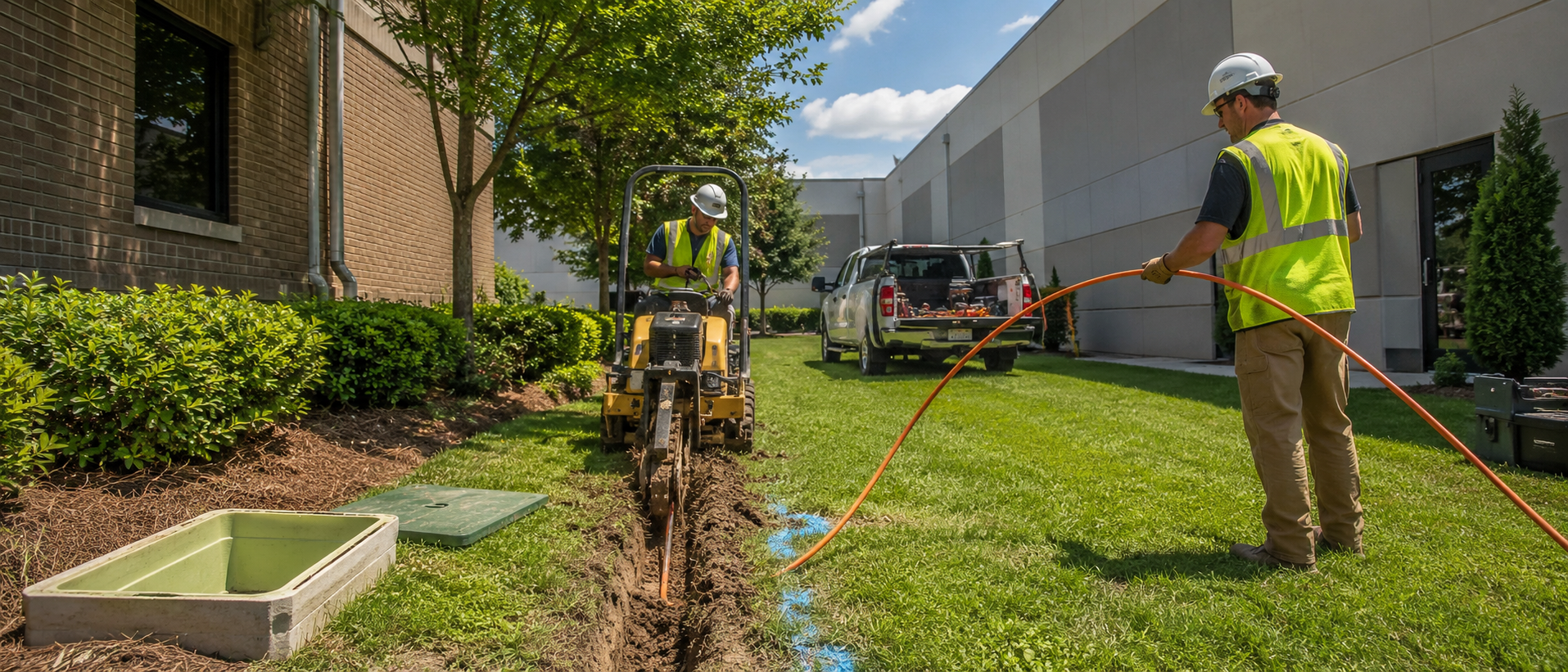
Outside Plant Fiber & Telecom Infrastructure Services
Commercial fiber construction, building-to-building connectivity, underground fiber infrastructure, and enterprise telecom deployment throughout Georgia, the Southeast, and nationwide.
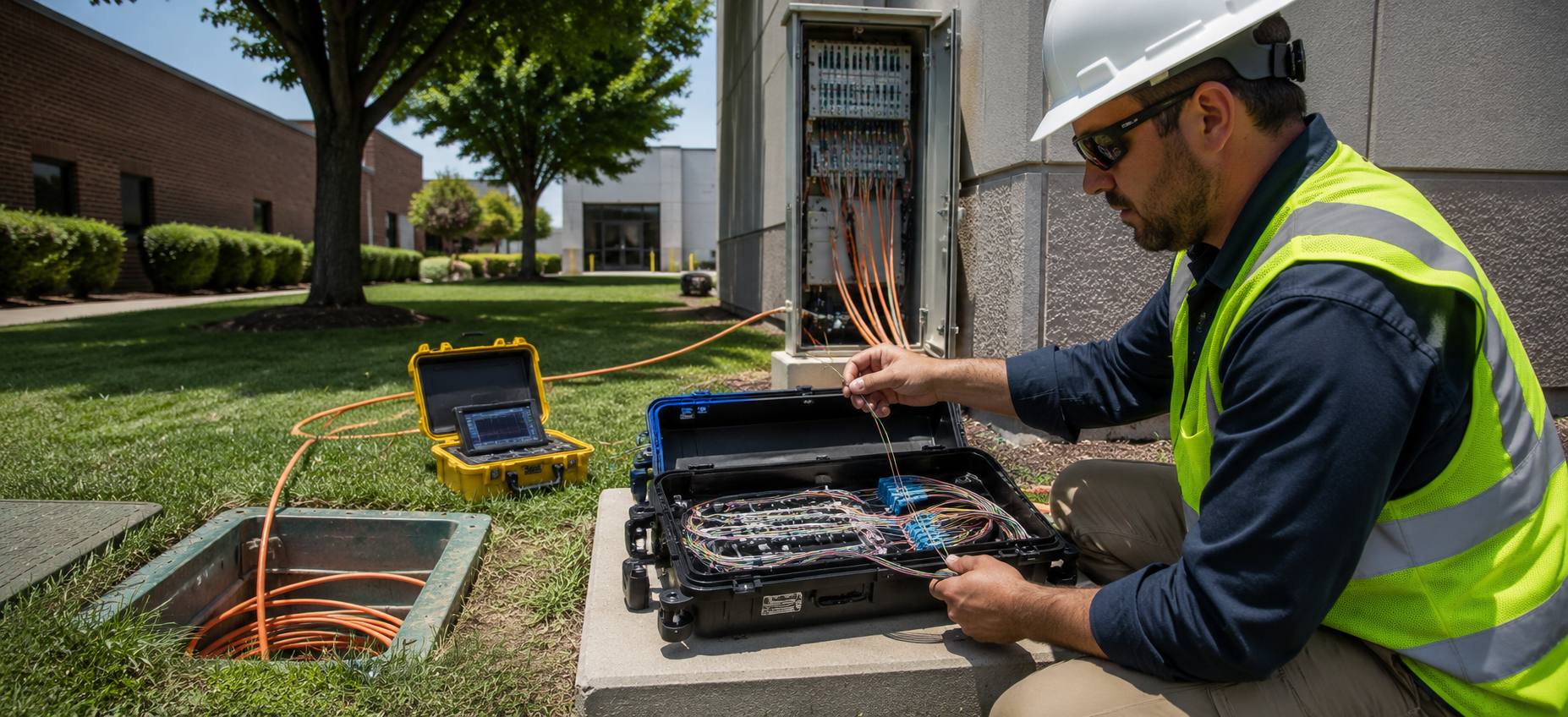
What is outside plant (OSP)?
Outside plant refers to all of the telecommunications infrastructure that lives outside the four walls of a building — the fiber, conduit, vaults, and pathways that carry voice and data between buildings, across a campus, and back to the carrier network. When a warehouse needs to talk to the front office across the parking lot, when a hospital adds a new patient tower, or when a carrier circuit has to reach a tenant suite, that connection is built with outside plant construction.
Outside Plant At a Glance
- Lives between and around buildings, not inside the walls
- Built for the elements — weather, traffic, and decades of service
- Single-mode and multimode fiber optic cable
- Underground conduit, vaults, handholes, and pull boxes
- Aerial fiber on utility poles and strand
- Directional boring and trenching for new pathways
The pieces of an OSP network
Every outside plant project is assembled from the same core building blocks. The combination depends on the site, the distance, and what is already in the ground:
- Fiber optic infrastructure — single-mode and multimode backbone
- Underground conduit — HDPE and PVC duct banks
- Handholes & pull boxes — access for splicing and pulls
- Utility pole infrastructure — permitted attachments
- Aerial fiber — lashed or ADSS span construction
- Directional boring — trenchless road & lawn crossings
- Trenching — open-cut conduit placement
- Fiber splicing — fusion splicing & termination
- Carrier connectivity — demarc and circuit extension
- Campus networking — building-to-building backbones

Two different disciplines
Inside plant (ISP) is structured cabling inside a building — Cat6/Cat6A drops, racks, and patch panels in a controlled environment. Outside plant (OSP) is rated for the outdoors: direct-burial and gel-filled fiber, conduit, vaults, boring, and pole attachments engineered to survive weather, water, and traffic for decades. DataTel 360 handles both and ties them together cleanly at the building entrance.
Who performs OSP work?
Outside plant construction usually involves several specialized trades working together. Understanding who does what helps you scope a project correctly — and shows where a coordinating partner like DataTel 360 keeps everything moving in one direction.
Turnkey OSP Contractors
Handle the full lifecycle: engineering, permitting, route planning, construction, testing, and as-built documentation under one roof.
Utility & Boring Contractors
Specialists in horizontal directional drilling, road crossings, utility locating and avoidance, and conduit placement underground.
Telecom Infrastructure Contractors
Build carrier-grade outside plant: carrier support, OSP construction, and municipal and public-sector network projects.
Fiber & Low Voltage Integrators
Connect the dots for campus fiber, warehouse connectivity, healthcare facilities, manufacturing plants, and data centers.
Where DataTel 360 fits
DataTel 360 acts as your trusted project coordinator and telecom infrastructure specialist. We engineer the route, manage permitting, bring in vetted boring and construction crews, splice and certify the fiber, and hand you a documented, tested network — so you have a single point of accountability instead of juggling four separate trades.
OSP services offered by DataTel 360
From the first survey to the final OTDR trace, we cover the full scope of outside plant fiber and telecom infrastructure work for commercial, industrial, municipal, and carrier environments.
Full outside plant scope of work
Every item below can be delivered as a standalone scope or rolled into a turnkey project. Tell us the buildings you need connected and we engineer the rest.
Industries we build outside plant for
We work in environments where downtime is expensive and connectivity is mission-critical. Our outside plant fiber and telecom infrastructure work supports operations across the Southeast.
Warehousing & Logistics
Fiber linking offices, docks, and distribution buildings.
Manufacturing
Plant-floor and building-to-building fiber backbones.
Distribution Centers
High-bay and yard connectivity across large footprints.
Healthcare
HIPAA-aware fiber connecting multi-building campuses.
Education
Campus-wide fiber backbones for K-12 and higher ed.
Municipal Government
Inter-facility and public-sector fiber routes.
Public Safety
Resilient links for dispatch, EOC, and first responders.
Hospitality
Property-wide connectivity across hotels and venues.
Property Management
Shared telecom infrastructure for tenant buildings.
Commercial Real Estate
Connectivity that adds value to multi-tenant assets.
Data Centers
Meet-me and entrance fiber, cross-connects, and conduit.
Telecom Carriers
OSP construction and circuit extension support.
MSPs
White-label OSP delivery for managed service providers.
Utility Providers
Fiber along utility corridors and substation links.
Typical outside plant projects
These are the projects clients call us about most. If your situation looks like one of these, we have likely built something very close to it.
Warehouse Expansion Projects
Connecting offices, warehouses, and distribution facilities across a property with new building-to-building fiber.
Healthcare Campuses
Linking multiple medical buildings — clinics, towers, and support facilities — into one resilient fiber backbone.
Educational Facilities
Campus-wide fiber backbones connecting academic buildings, athletics, and administration across a district or campus.
Industrial Manufacturing
Production facilities that need rugged fiber infrastructure between plant floor, offices, and outbuildings.
Multi-Tenant Commercial
Shared telecom infrastructure and entrance pathways serving multiple tenants in one building or complex.
Carrier Circuit Extensions
Extending services from the carrier demarcation point to the customer's space when the building entrance falls short.
New Construction
Designing and placing telecom infrastructure during ground-up construction so pathways are ready before the doors open.

One partner from survey to as-built.
Most clients do not want to manage an engineer, a boring crew, a splicing tech, and a carrier separately. We coordinate all of it — route design, permitting, construction, fusion splicing, and OTDR-certified testing — and deliver documentation you can hand to any IT team or auditor.
Georgia & Southeast coverage
Headquartered in Atlanta, DataTel 360 builds and coordinates outside plant projects throughout Georgia and across the Southeastern United States — with nationwide reach through a vetted network of technicians, contractors, and telecom partners.
Georgia projects
We regularly build and coordinate fiber and telecom infrastructure work across the state, including:
Southeastern United States
Our regional footprint extends across nine states throughout the Southeast:
Multi-site projects, coordinated centrally
For clients with locations beyond the Southeast, DataTel 360 coordinates outside plant projects nationally through a network of vetted technicians, contractors, and telecom partners — giving you consistent standards, documentation, and a single point of contact across every site.
Why a Regional Partner Matters
- Local permitting knowledge by jurisdiction
- Crews familiar with regional utilities
- Faster response for site surveys
- One standard across every location
Why companies choose DataTel 360
An established commercial telecom contractor with deep fiber expertise and the resources to deliver across the region — and beyond.
Established 1998
More than 25 years building telecom infrastructure.
Commercial Focus
Built for business, industrial, and institutional sites.
Telecom Specialization
Outside plant and telecom infrastructure is our core work.
Fiber Expertise
Single-mode and multimode design, splicing, and testing.
Nationwide Resources
A vetted partner network for multi-site projects.
Vendor Neutral
We recommend what fits your site, not a single brand.
Carrier Coordination
Experienced working with carriers and demarc extensions.
Structured Cabling
We tie OSP cleanly into inside-plant cabling and racks.
Project Management
One point of contact from survey through as-built docs.
Emergency Support
Response capability for damaged fiber and outages.
Common OSP challenges we solve
Most outside plant projects start with a problem, not a blueprint. Here are the situations we are called in to fix — and how we approach each one.
No pathway between buildings
We engineer and place new conduit or aerial routes to link buildings that were never connected.
Fiber damaged during construction
We locate the break, re-splice or re-pull the affected segment, and re-certify the link with OTDR.
New warehouse construction
We place telecom infrastructure during the build so connectivity is ready on day one.
Utility conflicts
We coordinate locates and avoidance so new fiber routes clear existing gas, water, and power.
Limited conduit capacity
We add duct, use innerduct, or place new pathways when existing conduit is full.
Expanding campuses
We extend backbones and add fiber counts so new buildings drop onto the existing network.
Remote buildings without connectivity
We reach detached or outlying structures with directional boring and long-haul fiber runs.
Carrier demarc limitations
We extend the circuit from the carrier demarcation point to where you actually need it.
Construction delays
We sequence fiber and conduit work around the general contractor to keep schedules intact.
Fiber relocation projects
We reroute and re-splice fiber around demolition, road work, and site changes.
Outside plant & fiber questions
Straight answers to the questions we hear most about OSP fiber and telecom infrastructure work.
What is outside plant (OSP) construction?
What is the difference between inside plant and outside plant?
Does DataTel 360 install fiber optic cable outdoors?
What is fiber splicing and do you provide it?
What is directional boring and do you handle it?
What is the difference between trenching and boring?
Can you connect two or more buildings with fiber?
What is a campus fiber network?
What is a carrier circuit extension?
What is a telecom entrance facility?
What is OTDR testing and why does it matter?
Do you handle permitting for OSP projects?
How do you handle existing utilities in the ground?
What does conduit infrastructure include?
Can you build fiber for a warehouse or distribution center?
Do you support data center connectivity?
What areas of Georgia do you serve?
Do you work outside of Georgia?
Can you coordinate projects nationwide?
How do I start an OSP project with DataTel 360?
Have a question that is not listed here? Request a site survey or call 770-441-9999 and we will walk through it with you.
Planning an outside plant fiber or telecom infrastructure project?
Whether you need building-to-building fiber, underground conduit pathways, carrier circuit extensions, campus connectivity, warehouse networking, or telecom infrastructure support, DataTel 360 can help coordinate and execute your project — in Georgia, across the Southeast, or nationwide.